
Prime Minister Edi Rama used the UN podium to raise the alarm about the impact of artificial intelligence, digital platforms and disinformation on democracy. At the center of his speech, he placed what he called the “Flamingo Revolution,” which he presented as a case in which citizens were pushed to react even against a “phantom enemy” through fabricated narratives and targeted online distribution.
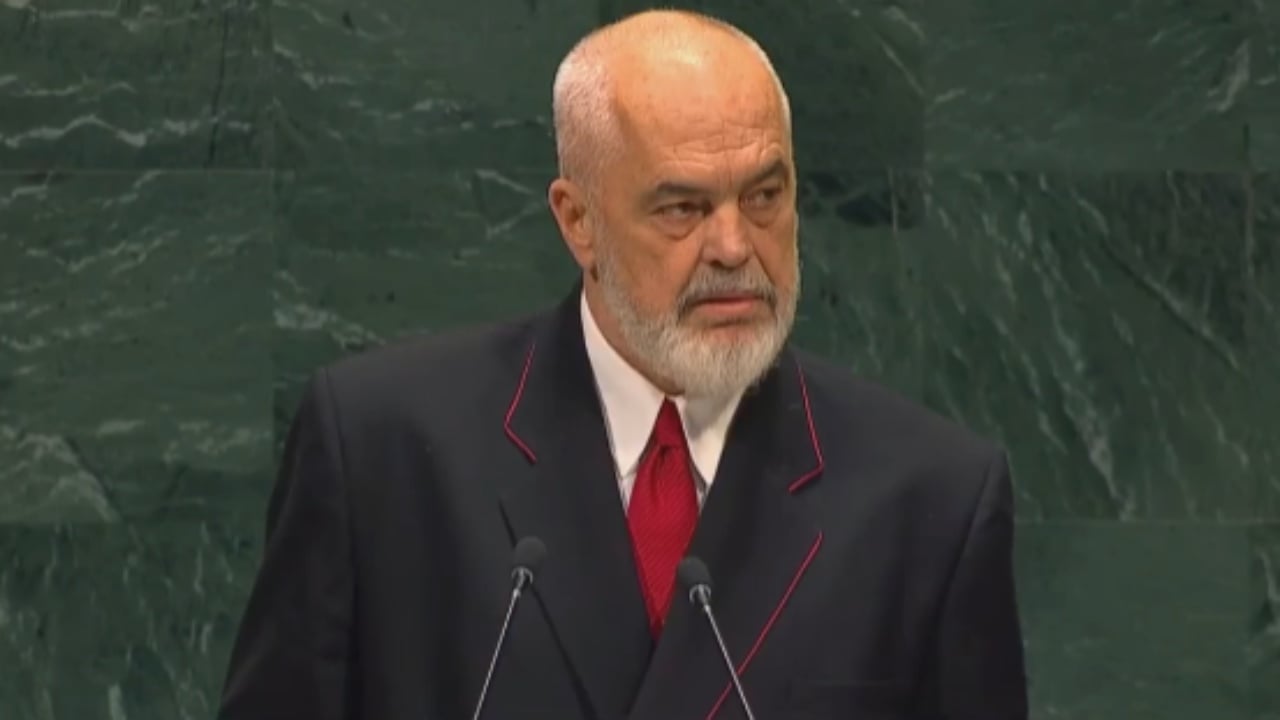
Rama took the debate from Tirana to the UN podium
In the speech delivered at the General Assembly in New York, Rama said the new challenge for democracies is no longer tied only to classic censorship, but to what he described as the “weaponization of the power of reach.” According to him, the danger lies in the way content can be amplified, personalized and directed at different groups of citizens.
The head of government argued that sovereignty is no longer undermined only at physical borders, but also in the digital space where public beliefs and judgments are formed. Along these lines, he called for more transparency on the origin of messages, their funding and the way they spread online.
The ‘Flamingo Revolution’ as an example of a fabricated narrative
According to the version presented by Rama, the “Flamingo Revolution” was linked to a fabricated narrative about an Israeli occupation of the Albanian coastline, an event that, according to him, never happened. He said this narrative was built, personalized and distributed through voices, pages and channels that enjoyed the trust of certain segments of the public.
Rama claimed that different citizens received different versions of the same lie: one person a story of national betrayal, someone else a religious provocation, while others received conspiracy theories about foreign occupation. According to him, all of this content fueled the same emotional and political mobilization.
The claim of protest manipulation and the role of algorithms
In his remarks, Rama said citizens may have had their own reasons to protest, but added that they also began protesting against a nonexistent enemy. At this point, he presented disinformation as a factor that turns fear into anger and anger into political mobilization.
He drew a distinction between the role of humans and that of technology, saying the algorithm did not invent the target, but found a way to activate hatred and spread it on a large scale. This, according to him, is a new model of systematic manipulation that no longer needs uniform propaganda aimed at the entire population, but functions at the individual level.
Call to expose amplification networks
Rama argued that when a lie can be artificially multiplied on a massive scale, the truth does not need to be censored in order to lose public weight. According to him, the citizen remains formally free to speak, but his or her voice is lost in the face of mechanisms of industrial amplification.
As a response, he called for “exposure” of the chain through which content spreads: who created the message, who financed it, whether it was distributed by people or machines, and why certain citizens were targeted. He also raised the question of whether public reactions were authentic, coordinated or prompted by foreign actors.
The statements at the UN once again place the debate on disinformation on politically sensitive ground, where governments speak about protecting democracy, but transparency over how such claims are identified, proven and addressed remains just as essential.
That is precisely where the real test lies: not in rhetoric about digital danger, but in the ability of institutions to produce verifiable facts when they speak about manipulation of public opinion.