
Prime Minister Edi Rama used the UN podium for a lengthy speech on artificial intelligence, disinformation, and the risk of political manipulation in the digital age. At the center of his argument was the claim that technology is being used to penetrate public opinion with personalized messages, and as a concrete case he cited the episode he linked to the so-called “revolution of the flamingos” in Tirana.
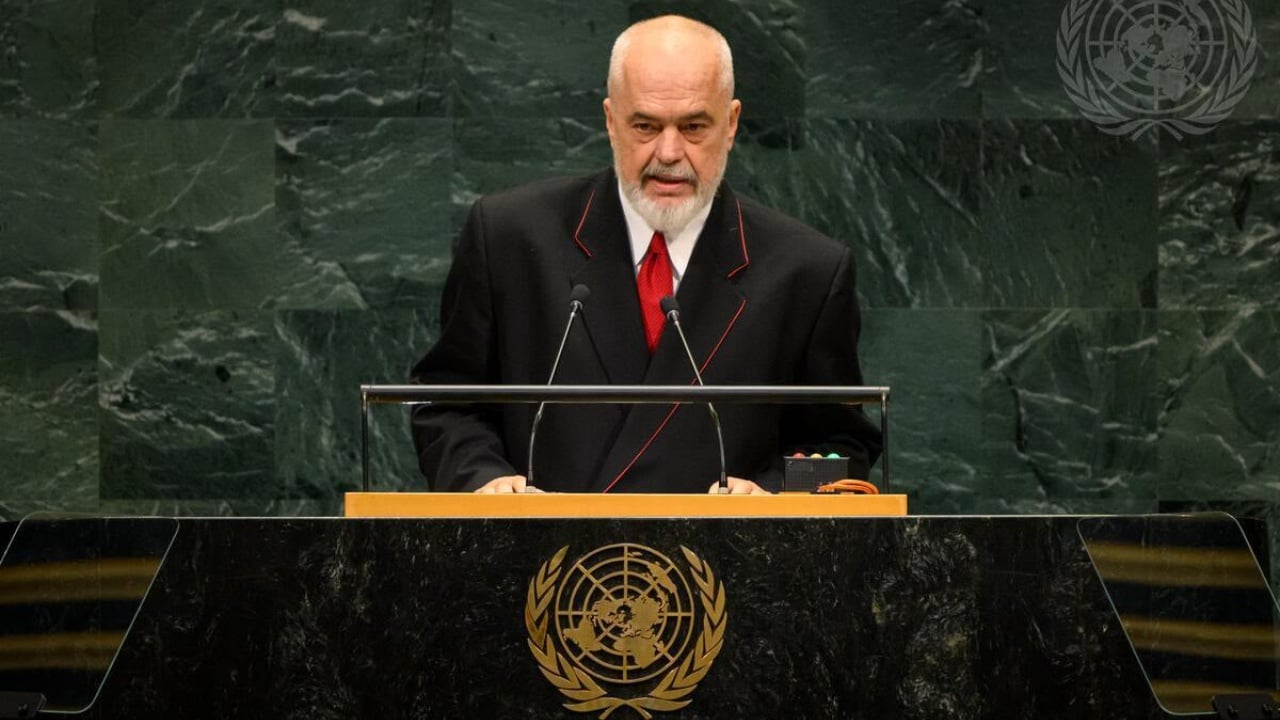
A speech on AI, power and control of opinion
Rama argued that the main danger from artificial intelligence does not lie in the idea of a machine going out of control, but in the fact that it can obey the wrong actors perfectly. According to him, these systems do not create ambitions or hatred on their own, but multiply the interests, fears and goals of those who use them.
At its core, the prime minister presented a concern that was more political than technological: not what the machine is in itself, but who commands it, who benefits, and who escapes responsibility when decisions or narratives produce public consequences.
The government speaks of transparency, but is also building a “digital mirror”
In his remarks, Rama said Albania has introduced artificial intelligence into the architecture of government through the tool called “Diella,” with the stated aim of making public services more accessible, procedures more transparent, and the state more accountable.
He also announced that the country is building a “digital mirror” supported by artificial intelligence, which according to the government’s version will identify manipulation in real time, test claims, and uncover coordinated structures for the distribution of content.
However, the very way this mechanism is described raises an unavoidable debate: where transparency ends and where the risk begins that those in power could gain new tools to intervene in the sphere of public information. Rama insisted that this is not a “ministry of truth,” but infrastructure for transparency.
The “flamingos” case and the narrative about the coast
To illustrate his thesis, Rama cited as an example an episode he described as a fabricated narrative about an “Israeli invasion” of the Albanian coast. According to him, this story was spread in different forms, tailored to the sensitivities of different groups of citizens, fueling fear, anger and mobilization.
The prime minister acknowledged that citizens may have had their own reasons to protest, but claimed that part of the public reaction was also directed against a “phantom enemy.” At this point, he connected the case with what he called the “revolution of the flamingos” in Tirana, as an example of how a narrative can be amplified and take on real political effect.
Along the same lines, Rama raised the concern that interference in opinion and elections no longer needs only traditional mass propaganda, but can operate through personalized messages for each voter.
Call for international rules and an alliance among democracies
At the end of the speech, Rama defended the idea that the answer is not slowing down artificial intelligence, but accelerating it under democratic, transparent and verifiable control. According to him, democracies should build shared warning systems and should not leave small countries outside the architecture of digital protection.
He called for citizens to be informed when political content has been artificially generated or manipulated, for transparency over who creates it and who finances its distribution, and for every public use of AI to have a clear chain of human responsibility.
The political message of the speech was clear: according to Rama, the battle of our time is not fought only at borders or at ballot boxes, but in the very mind of the citizen. And it is precisely there, according to the version he presented at the UN, that it will be decided whether technology serves freedom or manipulation.
Rama’s UN speech placed Albania in the role of a country that claims to speak about the risks of the digital age from its own experience. But alongside the alarm about manipulation, the question remains equally legitimate as to how many real guarantees exist that the state’s new instruments will not themselves turn into mechanisms of control over information and public debate.