
The political goal of Albania joining the European Union by 2030 does not appear to be off the table, but the road is becoming tougher and more tightly controlled. The European Commission’s new package for a larger union signals a process with stricter conditions, reversible steps and oversight that does not end with formal entry into the EU.
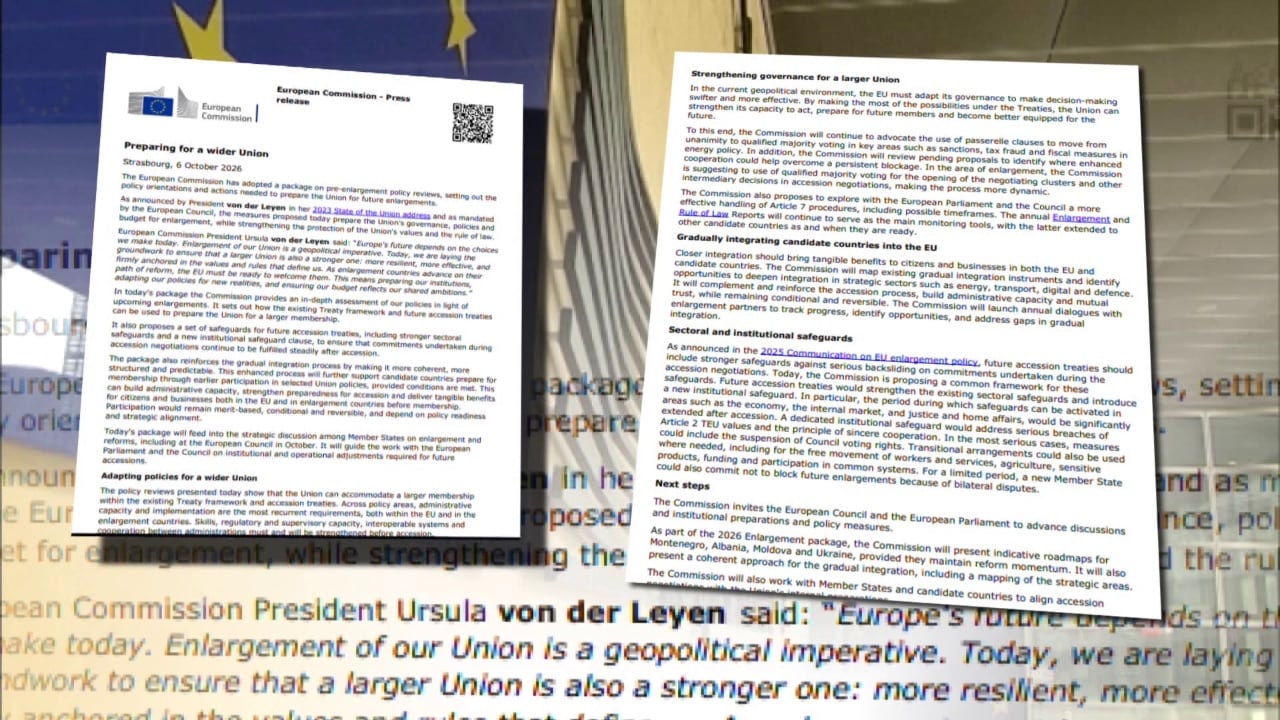
The new enlargement package changes the logic of the process
The European Commission has presented a new approach to enlargement, under which the accession of Western Balkan countries is expected to be phased. At its core, this means gradual integration, with benefits and progress directly linked to the level of compliance with the conditions.
This change makes the process less linear than it has often been portrayed in political discourse. Instead of a straight path toward membership, candidate countries face a mechanism in which forward movement can be slowed or even reversed.
Experts: 2030 remains possible, but not without political and institutional costs
Academic and integration expert Migena Leskoviku sees the new approach as stricter for Albania as well. According to her, it envisages conditional and reversible integration, supported by indicative roadmaps and mapping of strategic sectors, depending on the criteria that must be met.
Regarding the target the government has articulated for membership in 2030, her assessment is that the road is becoming more difficult, but not impossible. Under this reading, each country’s performance will depend on merit and concrete results, not simply on the political calendar.
Monitoring even after joining the EU, with sanctions on the table
One of the strongest signals of the new package is that scrutiny will not end with admission to the Union. New countries are expected to remain under oversight even after accession, to verify whether the commitments made during negotiations continue to be implemented.
In cases of non-compliance, punitive measures are envisaged, ranging from financial sanctions to restrictions on voting rights on important issues. Brussels’ political message appears clear: the EU does not want to repeat problematic precedents with member states that later challenge democratic standards and the rule of law.
The debate shifts to EU decision-making and the October summit
The new package also seeks to affect the way enlargement decisions are taken, by proposing the replacement of unanimity with qualified majority voting. If this moves forward, it would mark a politically significant change for the entire process of admitting new members.
Discussions are expected to continue at the European Council meeting on October 15 and 16, where enlargement with the Western Balkans remains one of the issues to be tested not only at the technical level, but also in the real political will of member states.
For Albania, this means optimistic rhetoric about fast deadlines is not enough. With tougher rules and longer oversight, the main test remains with institutions, democratic standards and the ability not to turn European integration into a domestic political slogan.