
The standoff created between lawyers and the Special Court Against Corruption and Organized Crime (GJKKO) has now moved to the institutional level, as the consequences are weighing on court proceedings and the parties in the courtroom. At the Commission on Citizen Initiatives, Cooperation and Institutional Oversight, the head of the High Justice Inspector (ILD), Artur Metani, indicated that the intervention of the institution he leads has clear limits and cannot be seen as an automatic solution to the open crisis.
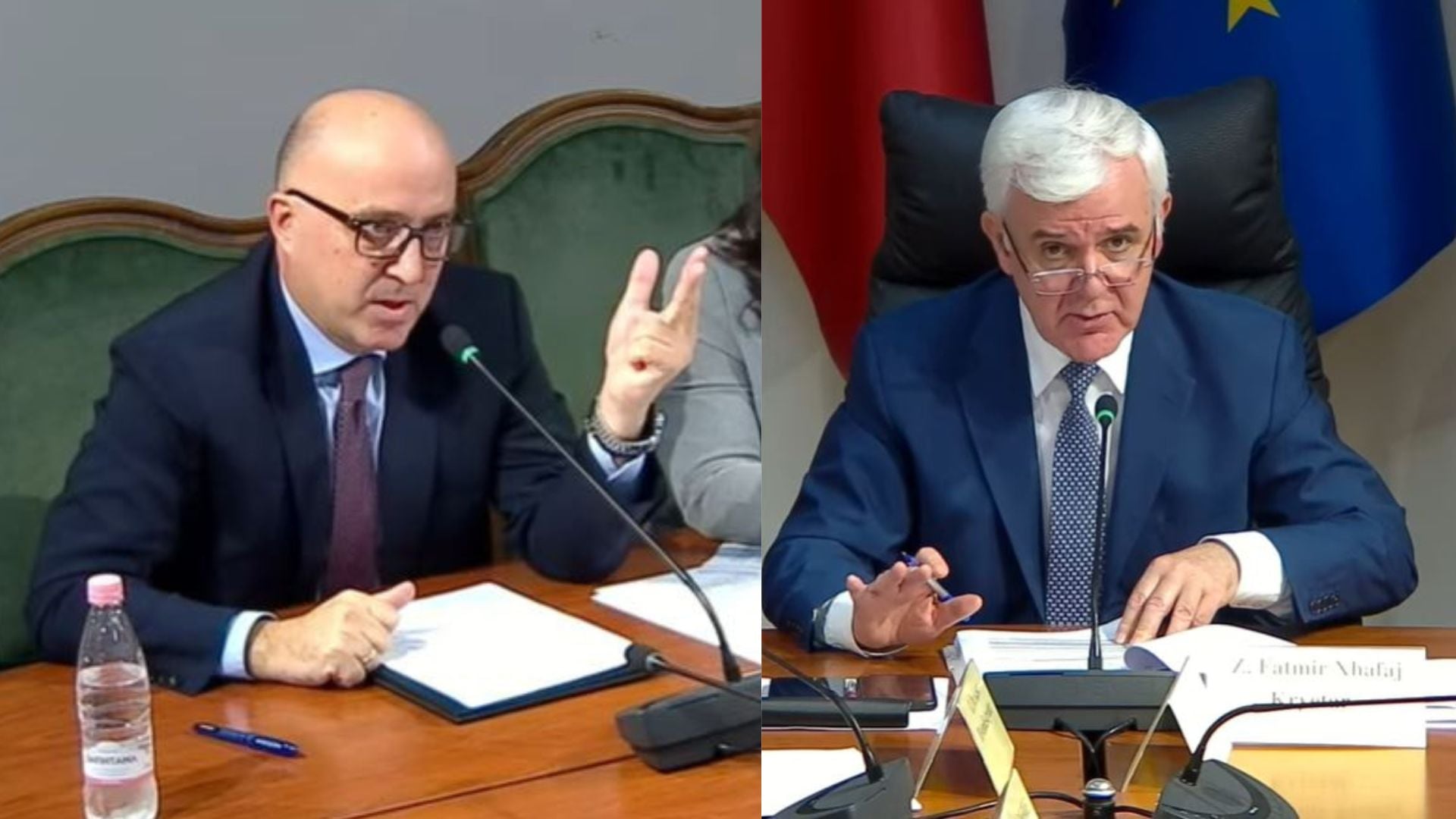
Xhafaj seeks a more active role from ILD
During the commission discussions, Fatmir Xhafaj raised concerns about the situation at GJKKO, stressing that the public clash between lawyers and the court is producing direct consequences for the justice system and for citizens.
According to him, the problem is not linked only to the relationship between the parties, but to the violation of due legal process and the prolonging of court proceedings. In this context, he raised for discussion whether ILD can use the powers granted by law to help overcome the standoff.
Metani: There are legal and institutional limits
Artur Metani said the situation is being followed with daily attention, but according to the account he presented, ILD’s intervention is not as direct as is being politically demanded in the commission.
He argued that any action by ILD would first be linked to verifying whether there are elements of a disciplinary violation. Beyond that, Metani presented the conflict as an issue that requires a table of talks between the parties more than a direct entry by the inspectorate, stressing that this goes beyond the institution’s powers.
Clash over the inspector’s role
Xhafaj took a more insistent position, arguing that there is room for ILD to intervene, precisely because in this case, according to him, a fundamental principle such as due legal process is being affected.
He stressed that the immediate effect of the situation is the postponement of proceedings and the increase of problems in the system, while recalling that checks, balances and mutual control are part of the architecture of the justice system itself. In this reading, ILD is seen as a link that cannot remain entirely outside the debate.
Partnership with the commission, not a promise of a solution
For his part, Metani expressed readiness to cooperate with the commission, stressing that the relationship between ILD and this forum should serve to share concerns and exercise the oversight role toward justice institutions.
He added that the commission may also request specific thematic inspections from ILD, if it deems them necessary. However, the main message left by the session was that ILD considers itself a partner in the process, but not the institution that can unblock this crisis on its own.
The debate in the commission highlighted not only the standoff at GJKKO, but also the institutional lack of clarity on how a conflict that is already affecting the normal functioning of court proceedings should be addressed.
Whether there will be a real intervention mechanism remains unclear, while institutions are shifting responsibility from one table to another.