
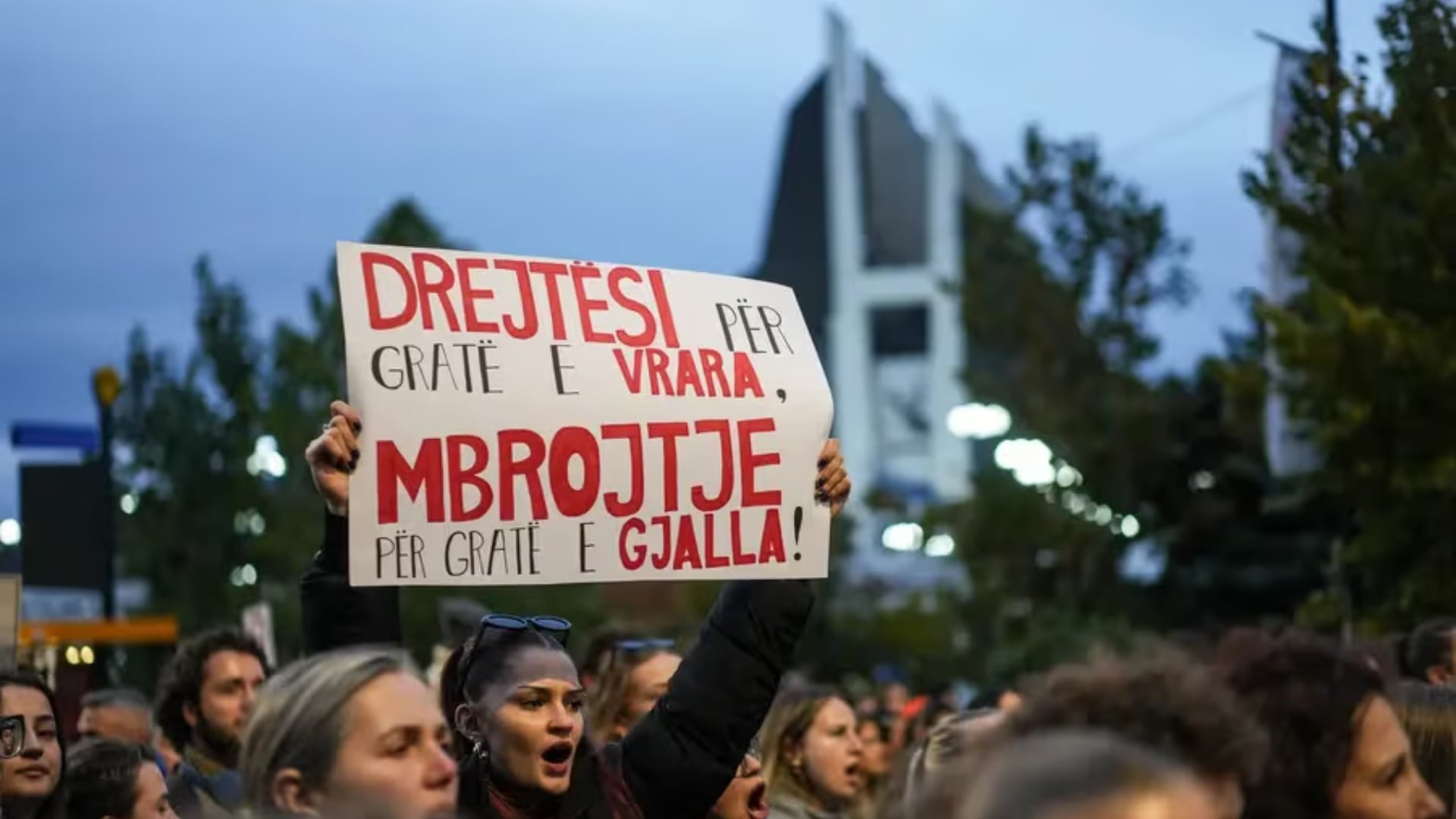
Public anger in Kosovo has not subsided. For the fifth consecutive day, citizens took to the streets in Prishtina after the killing of Arlinda Zekaj in Vitomirica, Peja, turning the march into a direct accusation against institutions for failing to protect women from violence.
Clear demands for political accountability
At Saturday’s protest, participants demanded the resignation of Justice Minister Donika Gërvalla and Interior Minister Xhelal Sveçla. Their call was linked to what protesters consider institutional responsibility for how cases of violence against women are handled.
The march began at Zahir Pajaziti Square and continued toward the Government building, while protesters carried banners with messages such as “The people’s ultimatum” and “Treat the killing of women as a national emergency.”
Strong accusations against the state
During the march, harsh slogans were heard against the institutions, including “Men kill women, the state helps them” and “The state has blood on its hands.” The message of the protest was clear: citizens are demanding that the institutional chain be held accountable for cases of violence and femicide, not just react after tragedy has already happened.
The fifth protest in a row shows that the case of Arlinda Zekaj is not being seen as an isolated incident, but as further proof of the failure of the mechanisms that should prevent violence and protect women’s lives.
Arlinda’s letter returned to the center of the protest
One of the strongest moments of the march was the reading of the letter that Arlinda Zekaj had sent to the Chief Prosecutor before the tragic event. With this act, protesters brought back into focus the most serious question being directed at the institutions: what was done with the warnings, and was action taken in time?
The public reading of this letter further deepened the demand for accountability, at a moment when trust in the institutional response appears to have been severely shaken.
Measures after the event and the resignation of the police chief
Arlinda Zekaj was killed on October 25 in Vitomirica, Peja, by her brother-in-law. After the incident, according to official announcements, 11 police officers were suspended, while suspension measures were also taken against the Chief Prosecutor and a prosecutor in Peja.
Also, the Director of Kosovo Police, Gazmend Hoxha, has resigned. However, the protest on the streets of Prishtina shows that, for part of the public, these measures are not being considered sufficient in the face of a case that has shaken the country.
Along the route of the march, Kosovo Police were present on the streets to maintain order and security.
Five straight days of protest have turned the case of Arlinda Zekaj into an open crisis of trust in the institutions.
Beyond the measures announced so far, public pressure is focusing on the question of whether responsibility will remain limited to suspensions and individual resignations, or whether it will truly affect the way the state responds to violence against women.