
He took over Albania among the poorest countries in Europe and, after nearly 14 years in government, is presenting it to us as an economic miracle that we are still right there!
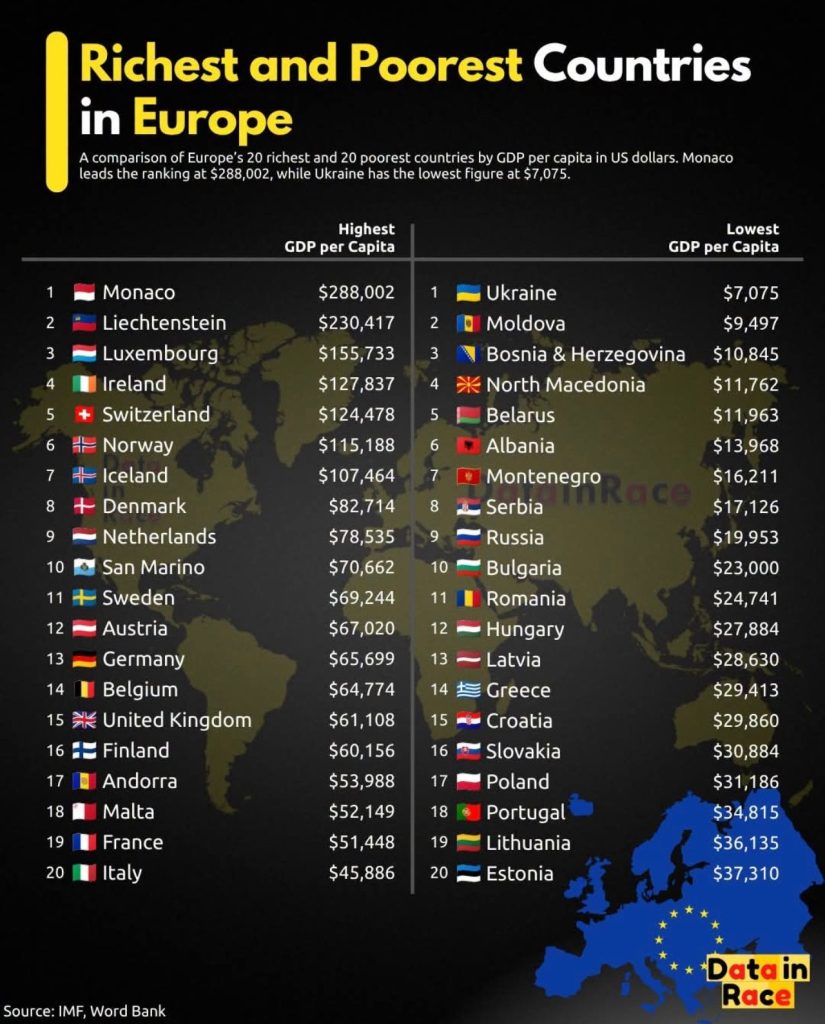
According to a ranking published on the basis of GDP per capita projections for 2026, Albania ranks as the sixth poorest country in Europe, with about $13,968 per resident.
Behind us? Ukraine, a country that has faced war for years, Moldova, Bosnia and Herzegovina, North Macedonia and Belarus.
This is Albania’s economic picture after nearly 14 years of Edi Rama’s government.
Fourteen years in power. Fourteen years of promises of development, strategic investments, economic transformation, Albania 2030 and the digital future.
And the result? Albania continues to be at the bottom of Europe in economic output per person.
But let us not rush into criticism! Perhaps next year, God willing, we will reach first place among the poorest. Then we too will be first in Europe for something!
Because a leader with such great ambitions cannot be satisfied with sixth place. Especially when it comes to a prime minister who talks about artificial intelligence as if Albania were the Silicon Valley of the Balkans.
While other European countries discuss how to increase productivity, real wages and the competitiveness of their economies, we are discussing websites with artificial intelligence, digital avatars and the technological revolution that will change public administration.
The prime minister is asking Albanians to embrace artificial intelligence in governance, while the simplest economic question continues to go unanswered:
How is it possible that after nearly 14 years in power, Albania remains among the six poorest countries on the continent?
And no, this is not about a lack of resources.
Albania has access to the sea, extraordinary tourism potential, natural resources, a strategic position, strong ties with European markets and a diaspora that continues to support the economy through remittances.
It has also had years of economic growth. According to the World Bank, nominal GDP per capita rose from about $4,543 in 2013 to about $12,998 in 2025.
So the economy has grown. That is not in dispute.
But the problem is not whether Albania is richer than it was 14 years ago. The problem is how much it has advanced compared with Europe and how much of that growth has been translated into real well-being for citizens.
Because it is not enough to show graphs going up when your country continues to remain at the bottom of the European table.
It is not enough to talk about billions of euros in investments if you do not explain how they are increasing productivity, purchasing power and the economic opportunities of Albanians.
It is not enough to build a spectacular Albania in government presentations when the real Albania continues to face large economic gaps compared with the rest of the continent.
And above all, it is not enough to announce another revolution every year when the results still require explanation.
Artificial intelligence can produce a website, an avatar, a speech or a grand presentation. But it cannot produce prosperity simply by changing the appearance of government propaganda.
After nearly 14 years, political responsibility for the economic results cannot endlessly be sought in previous governments.
Edi Rama has had enough time to implement his economic vision. He has had the power, the budgets, the administration and the opportunity to define the country’s priorities.
Therefore, today the debate should not be about how nicely Albania is presented on screen, but about how close it really is to Europe’s economic standards.
Because a country does not become rich from the number of strategies adopted by the government, nor from the amount of artificial intelligence it puts on websites. It becomes rich through productivity, investments that create value and well-being that reaches citizens.
Until then, let us continue to celebrate the miracle!
We are sixth from the bottom in Europe, but at least we have ambitions to become world leaders in artificial intelligence.
And if we continue like this, one day perhaps we will ask artificial intelligence itself to explain to us where Edi Rama’s economic miracle ended up.