
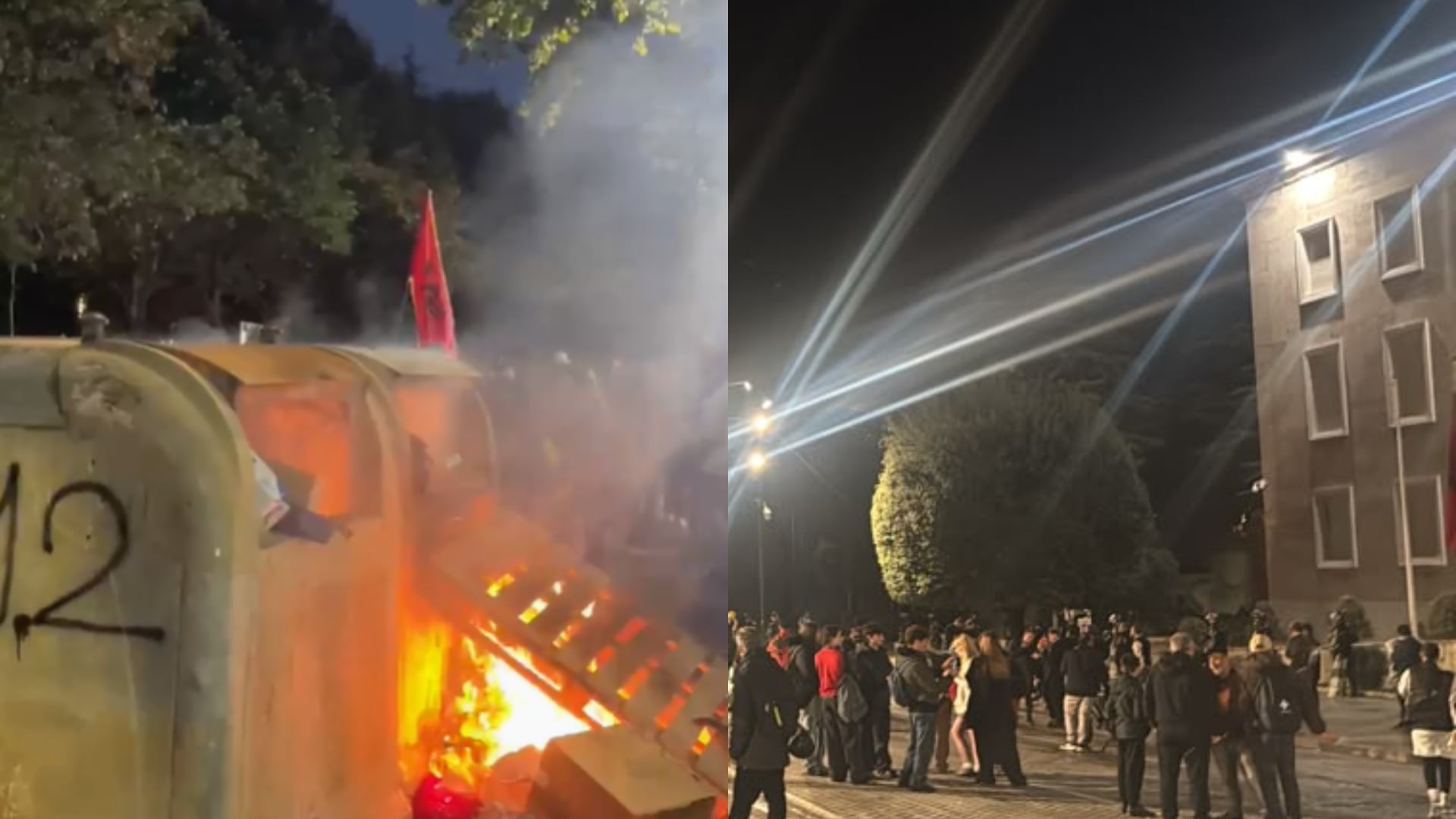
The student protest in Tirana ended after about five hours, leaving behind traffic disruption at several key junctions in the city, burned trash bins and episodes of tension near central institutions. The rally came for the second time within the week, while the large police presence showed that authorities were expecting the situation to escalate.
The rally began at the Ministry of Education
The students initially gathered in front of the Ministry of Education, but their stay there was brief. The protest then took the form of a march through the capital’s main streets.
During this phase, the burning of trash bins was reported, shifting attention from the protest’s demands to the management of public order as well.
From Zogu i Zi to 21 Dhjetori, with roads blocked
The protesters marched toward Zogu i Zi, where traffic was brought to a standstill. The movement then continued toward the 21 Dhjetori area, another important artery for movement in Tirana.
On the streets, railings removed from sidewalks and placed in the middle of the roadway were seen, along with advertising signs engulfed in flames. The footage showed a protest with a direct impact on urban life and public safety.
Police on the ground, but at a distance
According to the official version, around 700 police officers were deployed on the ground for the smooth running of the rally and to guarantee order and security. Through a megaphone, law enforcement called on protesters to clear the road and not obstruct the movement of vehicles.
The police marched parallel to the protesters, but the distance between the sides was maintained for most of the movement. This avoided direct clashes, although tensions were still present.
Stop at the Prime Minister’s Office and tensions near Parliament
After passing along the Small Ring Road, the protest stopped at the Prime Minister’s Office. In this segment, tensions were also reported near the Presidency of Parliament, in another sign that the rally was approaching the capital’s most sensitive institutional points.
During the protest, the students also conveyed the message, “We do not forget,” keeping the rally tied to the reason that has brought them back into the streets again within just a few days.
Without opposition support on the ground
Democrats were not seen at this protest. Their non-participation came after, according to reports, the students’ refusal and the incidents in the previous protest influenced Sali Berisha not to call a rally in support of them.
This left the protest politically exposed and without the usual cover that parties try to give street rallies, even when they seek to benefit from them.
The end of the protest after five hours does not diminish the fact that Tirana experienced another evening of blocked roads, damage to public space and a massive police presence.
The event brings back to the fore the question of the institutions’ ability to hear discontent without allowing it to slide into confrontation and urban chaos.