
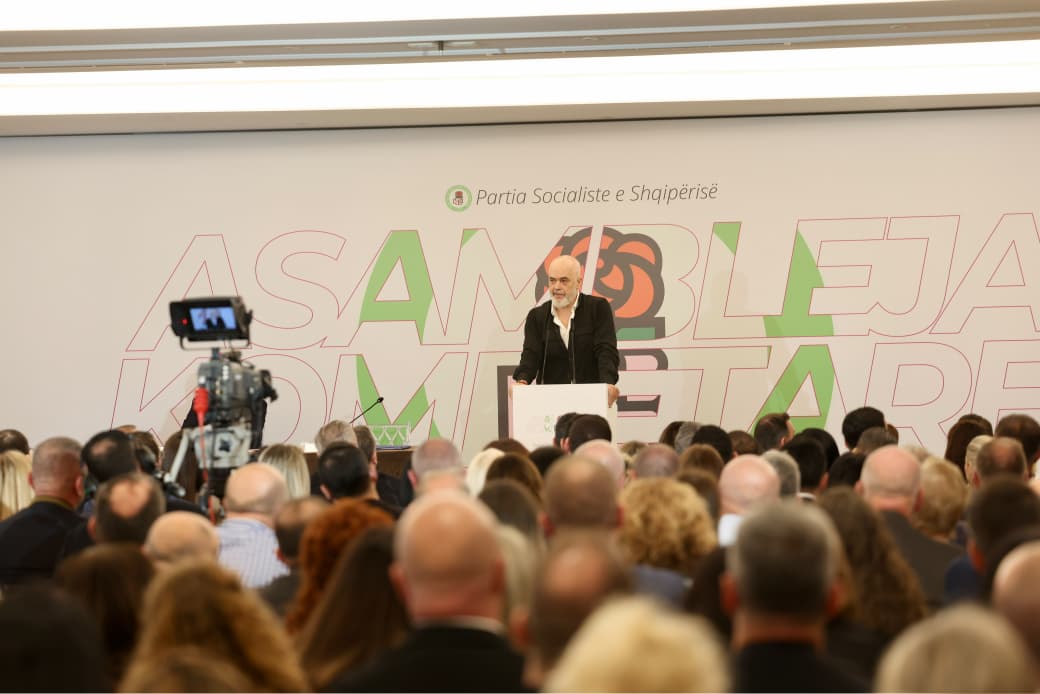
The National Assembly of the Socialist Party turned into an arena of internal clashes after Edi Rama sought Elisa Spiropali’s expulsion from the party, but the initiative did not even make it to a vote. The development exposes tensions that are usually kept away from the cameras and shows that not every decision by the chairman passes without resistance within the majority.
The expulsion request stalled inside the meeting
According to information made public from the meeting, Rama requested Spiropali’s removal from the Socialist Party, but the issue was not put to a vote in the Assembly. Objections raised during the discussions and the support the MP received from well-known PS figures proved to be the obstacle.
At the meeting, Fatmir Xhafaj, Pandeli Majko and Erion Braçe lined up against her expulsion. This positioning suggests that within the party there are serious reservations about the way political disagreements are being handled and the disciplining of critical voices.
Sharp exchanges between Rama and Spiropali
The debate did not remain only procedural, but extended into direct political language. Rama addressed Spiropali with a strong comparison, telling her: “For you, I was Skanderbeg and you were Mamica, but you threw stones at your own house and became a flamingo.”
Spiropali, for her part, opposed the idea that she had acted against the PS chairman. According to the version reported from the meeting, she said she had been against the way ministers and directors are chosen, as well as against those who, in her view, abuse power and exploit the Socialist Party.
She is also said to have stressed that she sees no procedure that would lead to her expulsion, while also drawing attention to the position she previously held as Speaker of Parliament.
Not only Spiropali, but also debate over measures against other names
At the same meeting, the name of Plarent Ndreca was also mentioned. According to Fatmir Xhafaj’s position, measures could be taken against Spiropali and Ndreca, but not to the point of expulsion from the party.
This detail shows that there was no single position within the PS on how severe the measures should be. Even when there is internal criticism, part of the older socialist figures appear to oppose extreme solutions.
Closed-door assembly and reorganization for Tirana
The meeting began with Rama’s request to halt the media broadcast, on the grounds that he initially wanted to share several messages with the members of the forum. The decision to keep the main discussion closed to the public comes at a time when the majority is facing political tensions and growing criticism in the public sphere.
Another important issue was the reorganization of the PS political leadership. For Tirana County, Rama entrusted the leadership to Albana Koçiu and Ervin Demo, who are expected to coordinate the socialist structures in the capital ahead of the upcoming local elections.
Rama’s political messages and the background to the meeting
In the part open to the media, Rama focused on European integration and, according to his statements, described as historic the European Commission’s recommendation to begin preparations in 2027 for Albania’s EU accession treaty. He called for the mobilization of socialist structures for the local elections of May 9, 2027.
The Assembly is the first after around nine months and is taking place in a tense political climate, as the majority enters an electoral organizing phase and faces student protests and opposition action. It is precisely against this backdrop that the clash with Spiropali makes the strain within the governing camp even more visible.
The fact that the request for Elisa Spiropali’s expulsion did not even make it to a vote is a political signal that is difficult to downplay. Beyond the strong rhetoric from the podium, the Assembly showed that the chairman’s control over the party does not appear as linear as it is presented in public.
Instead of a clear decision-making outcome, the PS emerged from the meeting with an open conflict, internal objections and unanswered questions about how decisions are made in the party that holds power.