
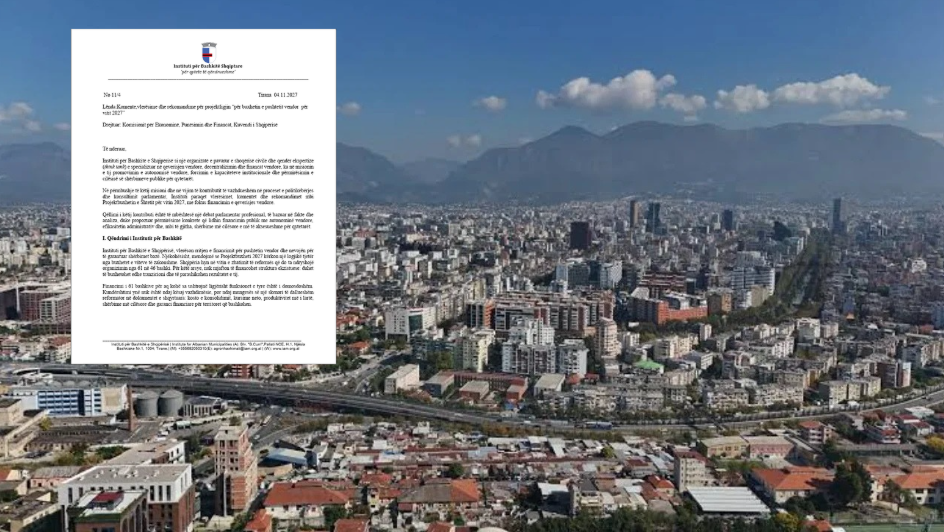
The 2027 draft budget for local government is facing serious questions, as the Institute for Municipalities has sought intervention from Parliament on an issue that directly affects public money and how the new local map will function. According to the document submitted to the Committee on Economy, Employment and Finance, the planned funding still does not provide a full picture of the costs involved in the transition from 61 to 46 municipalities.
A budget unlike any other for a reform with financial consequences
The Institute welcomes the increase in funding for local government and the continuation of basic services, but argues that the 2027 budget cannot be treated as a routine budget. The reason, it says, is that territorial reform requires not only coverage of current spending, but also dedicated financing for the transition.
At its core, the demand is for the government to calculate in parallel both the financing for the 61 municipalities as long as they continue to exercise their legal functions, and the costs of moving to the new structure of 46 municipalities. The Institute also calls for the expected savings to be made clear, along with the concrete impact the reform will have on services for citizens.
An increase on paper does not guarantee more autonomy
In the analysis submitted, the total unconditional transfer for local government is projected to reach 49.4 billion lek in 2027, up from 47.3 billion lek planned in the 2026 draft budget. This translates into an increase of about 2.4%.
But according to the Institute, the nominal increase should not automatically be read as more financial autonomy, more investment, or better services. It calls for a clear distinction between funds going toward legal obligations, the wage effect, and the actual new financing for local government.
The distribution formula remains based on the old map
One of the main criticisms concerns the way funds are distributed. According to the Institute, the current formula continues to rely on the existing 61 municipalities, while the reform targets 46 new local units.
For this reason, it is calling for the publication of a new financial simulation based on the future map, so that it is clear which municipalities benefit and which risk losing funding after the reorganization. Without such a table, the debate on the reform remains partial and without a full public balance sheet.
The reform’s financial balance sheet is missing
Another issue raised is the lack of a full financial balance sheet. The draft budget documents, according to the Institute’s assessment, do not provide a clear picture of consolidation costs, inherited obligations, the administrative costs of reorganization, and the real savings that may be created.
For that very reason, it proposes drafting a Financial Transition Plan for the 2027-2029 period. The plan should include assets, contracts, liabilities, personnel, ongoing projects, and the funding sources for the one-off costs of the reform.
Rural areas, the administration and the call for public reporting
The Institute also focuses on how the reform could affect local administration. According to it, the merger of municipalities should not be reduced simply to a reorganization of structures, but should be accompanied by increased productivity, stronger professional capacities, and improved speed of services.
Among the recommendations sent to Parliament and the Ministry of Finance are increased funding for rural and mountainous areas, concrete standards for sectoral services, and a review of the 200 million lek performance grant so that its criteria are aligned with the new territorial map.
Finally, it calls for the responsible institutions to report during 2027 on transition spending, savings achieved, staffing changes, investments by territory, and the quality of public services. For the Institute, the success of the reform is not measured by reducing the number of municipalities on paper, but by the real cost and quality of the services citizens receive.
The debate over the 2027 local government budget is highlighting a problem that goes beyond the numbers: if territorial reform is entering the implementation phase without a full public bill and without clear guarantees for services, then the financial and administrative burden risks once again remaining with citizens and local units.
The demand for more transparency on the costs, savings and real beneficiaries of this move makes the discussion in Parliament more than technical: it is a test of how public funds are managed in the name of reform.