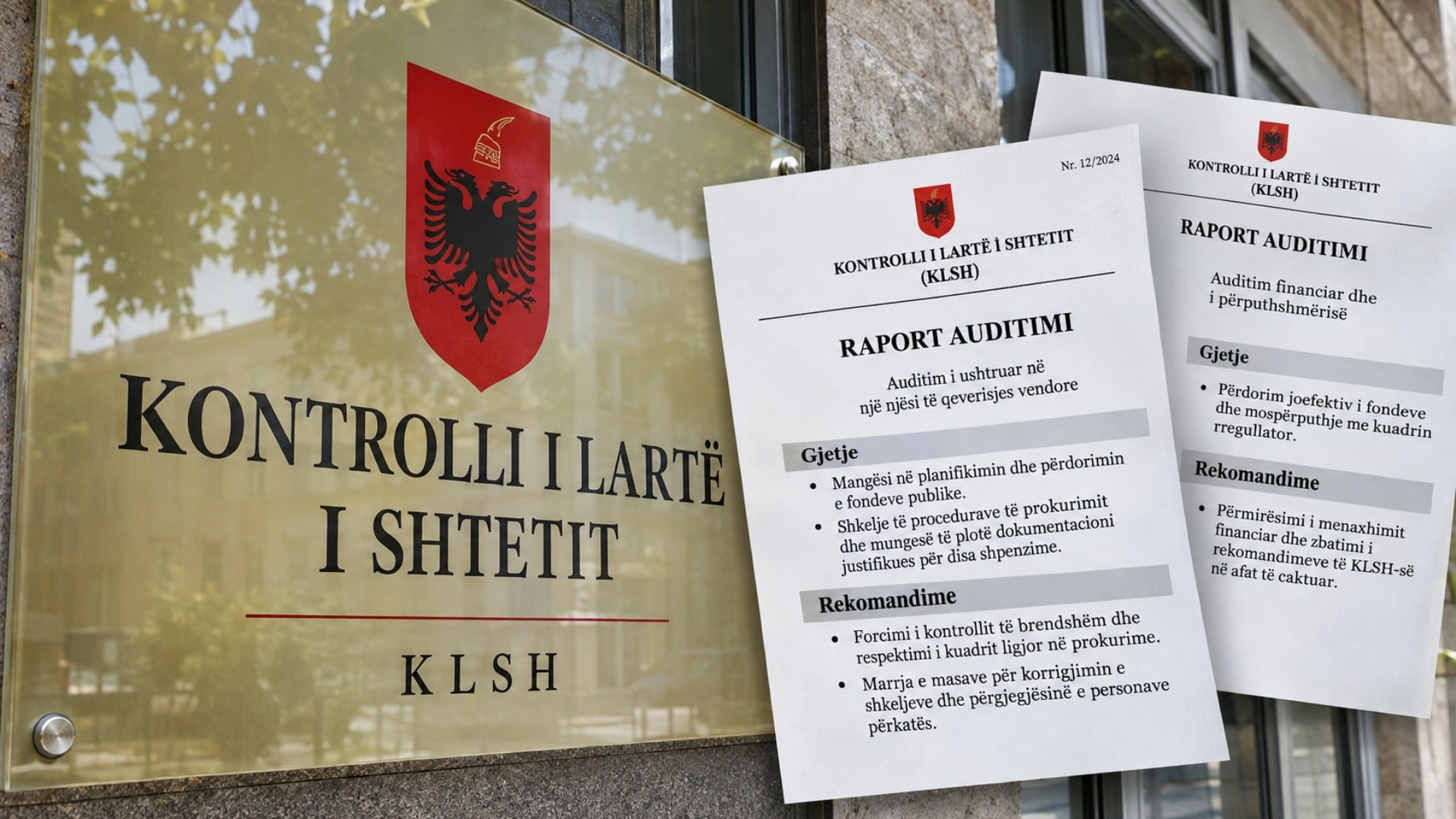
The High State Audit has published a series of audits during 2026 shedding light on how funds, assets and procedures have been administered in 17 municipalities across the country. From economic damage and uncollected obligations to tenders with winners who, according to the reports, did not meet the criteria, the picture emerging from the official documents is serious and raises major questions about internal control in local government.
A problematic picture in 17 municipalities
According to reports published during 2026, the audits covered the municipalities of Durrës, Gjirokastër, Pogradec, Mat, Roskovec, Tepelenë, Prrenjas, Memaliaj, Poliçan, Belsh and Fushë-Arrëz, as well as earlier audits of Fier, Korçë, Elbasan, Berat, Lushnjë and Sarandë.
KLSH mainly reviewed activity from 2023 to 2025 and in most cases requested recovery of damages, collection of obligations, correction of financial statements, and administrative or disciplinary measures. The very fact that the same issues are repeated across so many local units shows that these are not isolated cases, but continuing weaknesses in the management of public money and public assets.
Durrës and Lushnjë, two of the most striking cases
In the Municipality of Durrës, according to KLSH, economic damage of 30.3 million lek was identified in the implementation of public investment contracts. At the end of 2024, there were also 1.86 billion lek in unpaid obligations from businesses and households.
The report on Durrës highlights shortcomings in 27 procurement procedures, where problems were found with qualification criteria and cases in which operators that did not meet tender requirements were declared winners. Likewise, in five cases, the inaccurate calculation of the infrastructure impact tax led to 18.7 million lek in missing revenue.
Another serious element in the report is linked to territorial control. According to the audit, in 200 cases procedures for enforcement orders against illegal constructions had not been pursued, while in 23 procedures with possible criminal elements, the indications had not been referred to the competent authorities.
In Lushnjë, the report raises another alarm over the way public assets were recorded. During 2024, 12 buildings were registered at a value of 1 lek each, while 648,608 square meters of land, agricultural plots and quarries appeared with a total value of only 17 lek. KLSH also identified a discrepancy of 18 million lek between accounts and inaccuracies in depreciation, with an effect of 120.4 million lek for roads, networks and waterworks.
Financial statements under question in Elbasan, Fier, Korçë and Sarandë
In Elbasan, according to the report published in March 2026, the municipality had declared about 1.31 billion lek more in revenue in the 2024 balance sheet, while the financial result had been presented as 62.4 million lek lower than it should have been. Auditors also found a discrepancy of about 1.2 billion lek between accounts, as well as 45 projects worth 127 million lek with no information on the completion of the investments.
In Fier, 551 million lek in unpaid obligations from businesses had not been reflected in the accounts. The report also notes problems with the registration of investments and public assets, while investments planned for 2024, worth 864.5 million lek, were carried out only to the extent of 37%.
In Korçë, the municipality had not recorded in its balance sheet shares and participations in commercial and public companies worth 722.6 million lek. Due to the inaccuracies identified, KLSH issued a qualified opinion with reservation on the financial statements.
In Sarandë as well, assets and investments not clearly identified in the accounts were noted, along with an undervaluation of the municipality’s participation in the capital of the regional water supply and sewerage company.
Tenders, uncollected taxes and problematic investments in other municipalities
In Pogradec, the audit found incomplete documentation or documentation not compliant with the law in 11 of the 14 reviewed files for construction permits and usage certificates. There were also 292.1 million lek in unpaid obligations.
In Gjirokastër, only 59.5% of planned investments financed from own-source revenues and transfers were carried out, while in four of nine procurement procedures unclear or unjustified criteria were identified.
In Mat, Roskovec, Tepelenë, Prrenjas and Memaliaj, the reports speak of economic damage, missing revenue, tender winners who according to the audit did not meet the criteria, and problems with the registration of public property. In Memaliaj, for example, KLSH found violations in eight procurement procedures with contract values of 320.7 million lek excluding VAT.
In Poliçan, 67.1 million lek in uncollected obligations and shortcomings in the administration of 2,294 public properties were identified. In Belsh, problems were found in internal control and a lack of strategy for risk management. In Fushë-Arrëz, auditors raised questions about revenue planning, as implementation reached 201% of the plan, which according to the report was not supported by reasoned analysis.
Overall, the KLSH reports present a picture in which municipalities not only face inefficiency and administrative weaknesses, but in many cases also have direct problems with tendering, asset reporting and revenue collection.
It remains to be seen how many of the auditors’ recommendations will actually be implemented and how many of these findings will lead to concrete accountability, beyond routine formulas of administrative correction.