
A sharp reaction from Prime Minister Edi Rama toward Russian journalist Chay Bowes has once again brought attention to the political clash over the protests in Tirana and how they are used in international narratives. In a post on X, Rama labeled Bowes a “clown of Russian propaganda” after the European Union included him on its list of sanctioned individuals.
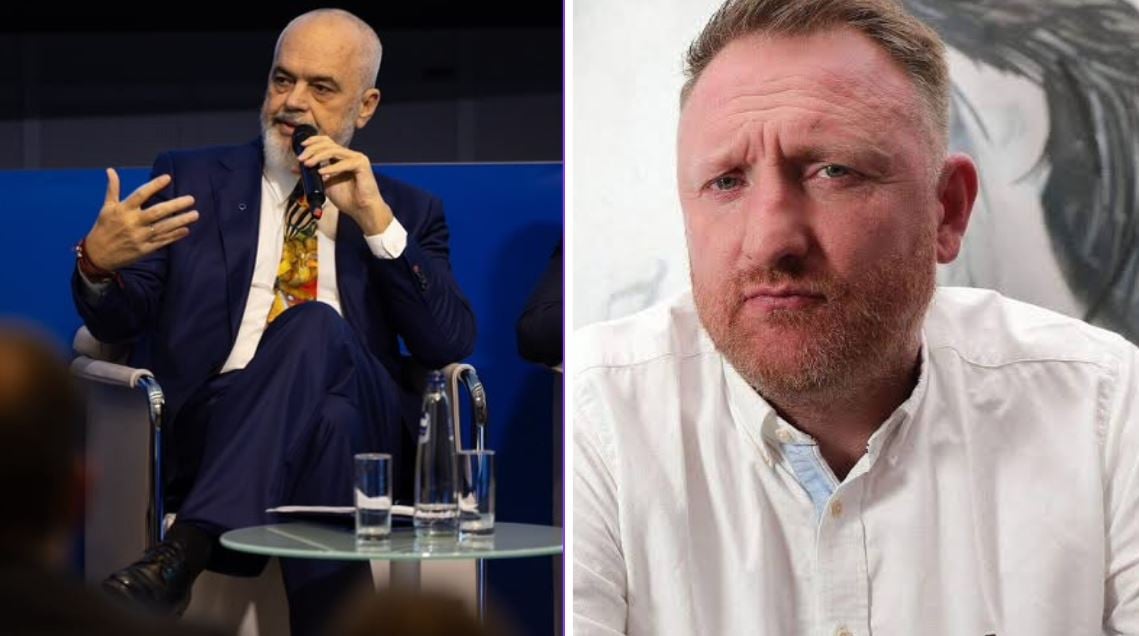
Rama’s reaction after the EU decision
Rama shared several of Bowes’ earlier posts, in which the Russian journalist appeared in support of the protests in Albania. The prime minister chose to respond with irony, linking his stance to the decision just announced by the European Union.
In his post, Rama wrote that Bowes was sanctioned by the EU as a figure involved in Russian propaganda and used this to question why Albania had become the subject of his public interest.
What the EU’s official version says
According to the European Union’s decision, Chay Bowes has been included on the list of people accused of information manipulation and spreading narratives in support of Russia’s war against Ukraine.
According to the EU, he has supported coordinated information influence operations in Moscow’s favor. The measures announced include the freezing of any assets he may have in EU territory and a travel ban to member states.
Posts about the protests and their political use
The clash comes at a time when the protests in Tirana are also being used as material for debates abroad, raising questions about how Albania’s internal developments are being drawn into wider propagandistic or political networks.
For his part, Rama presented Bowes’ interest in Albania as part of a narrative attack against the country and linked it to Albania’s progress toward membership in the European Union. This remains a political thesis articulated by the prime minister in his public reaction.
The prime minister’s political message
In essence, Rama’s reaction was not simply a personal response to a journalist, but also an attempt to place the debate over the protests within the framework of a clash between the government’s pro-EU course and actors who, according to him, feed hostile narratives.
However, beyond the strong political language, the facts made public so far relate to the EU sanctions against Bowes and his posts about the protests in Tirana. The rest remains at the level of political interpretation.
The debate opened by this clash shows that the protests in Albania are not being read only on the domestic level, but also as ground for broader political and geopolitical narratives.
In this case, the verified element remains the EU decision on sanctions against Bowes, while interpretations about the motives and political target of his posts remain part of the public clash.