
Southern Europe is once again entering a summer of alarm, with wildfires spreading rapidly across Spain, France and other parts of the region. Amid extreme temperatures and parched terrain, thousands of people have been forced to leave their homes, while the growing toll in burned land is raising serious questions about institutional response capacity.
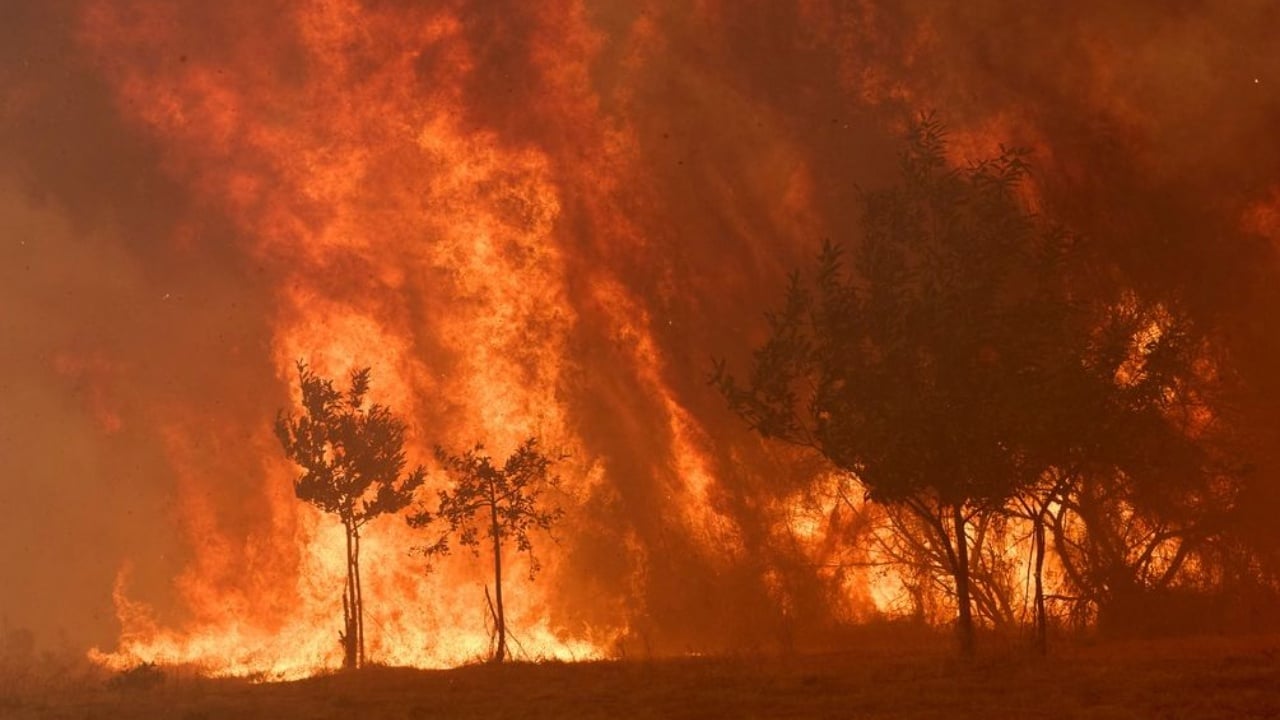
Spain in emergency during the third heatwave of the summer
According to the Spanish government, a state of emergency has been declared in the Madrid region and in the province of Ávila after the fires spun out of control during the third heatwave of the summer.
Temperatures have reached as high as 44.7 degrees Celsius, while around 10,000 residents have been evacuated in areas around Madrid. Military emergency units have also been deployed in the operation, a clear sign of the scale of the crisis.
Prime Minister Pedro Sánchez said that all available resources had been mobilized, while authorities urged citizens to follow official instructions. However, the scale of the flames is showing that control over the situation remains fragile.
France faces a giant fire near Bordeaux
In southwestern France, a massive fire near Bordeaux has burned more than 37,000 hectares of forest in just over 24 hours, according to official reports.
More than 18,800 people, including thousands of tourists, have been evacuated from campsites and holiday homes. French authorities also report that several homes have been destroyed.
Around 800 firefighters and four aircraft have been deployed to contain the flames, while the fire has also affected Cap Ferret, one of France’s best-known tourist areas. Road closures and the evacuation of thousands of residents have shown that the danger is no longer confined only to deep forest areas.
European figures point to an escalating crisis
According to the European Forest Fire Information System, more than 1 million hectares have burned in Spain since the beginning of the year.
Data from the same platform show that the area burned in the European Union up to July 22 has nearly doubled compared with the average of the past 20 years.
At the same time, a strong marine heatwave is affecting around 80% of the Mediterranean, with water temperatures up to 5 degrees Celsius above the 1991–2020 climate average. These indicators are making the crisis broader than a series of isolated fires.
Scientists’ warning: increasingly extreme scenarios
Experts warn that the combination of climate change and the abandonment of agricultural land is creating ideal conditions for fires of ever-greater scale.
Víctor Resco de Dios, a professor of forest engineering at the University of Lleida, said that extreme scenarios similar to those seen in California or Australia can no longer be ruled out.
He warned that “Dante’s Inferno”-type scenarios could be approaching, with fires engulfing hundreds of thousands or even 1 million hectares. Scientists’ assessment comes at a time when drought, heatwaves and damage to agriculture and ecosystems are emerging as parts of the same crisis.
The toll so far shows a Europe more exposed to major wildfires, while the response of authorities is being tested by the pace of escalation.
When burned areas rise year after year and mass evacuations become a routine part of summer, the alarm is no longer only meteorological, but becomes a matter of public management, land use and long-term policy.