
The confrontation between Sarajevo and Belgrade has deepened after ceremonies with state and military honors for Ratko Mladić in Serbia. Bosnia and Herzegovina Foreign Minister Elmedin Konaković announced that almost the entire diplomatic staff of the embassy in Belgrade will be withdrawn, a strong political move that once again exposes the unresolved crisis over the glorification of war crimes in the region.
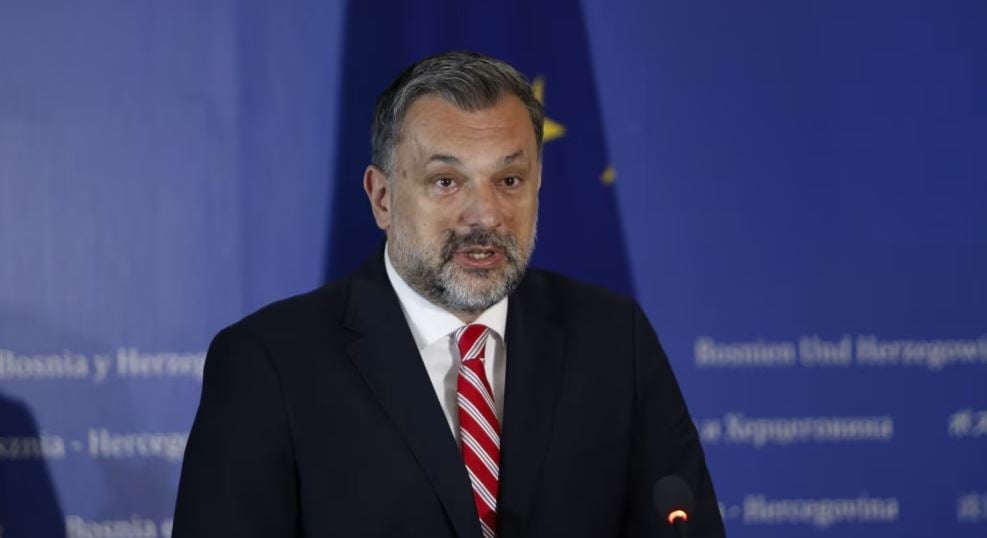
Sarajevo reduces diplomatic presence in Belgrade to a minimum
According to Konaković’s announcement, only the ambassador and the consul may remain in Belgrade, while the rest of the diplomatic staff will be withdrawn. The ambassador and consul are decided by the Bosnia and Herzegovina Presidency, which limits the room for immediate intervention by the ministry.
Consular services, according to the announced plan, are expected to be transferred to Bosnia and Herzegovina’s diplomatic missions in Zagreb and Podgorica. The decision comes in response to what Sarajevo considers the institutional normalization of honors for a man convicted of genocide and war crimes.
What prompted the decision
Konaković linked the measure to developments in recent days in Serbia following Mladić’s death: the funeral, the memorial ceremony and the messages displayed in public. He said that, if he had full authority, he would also seek a break in diplomatic relations with Serbia.
The point he called the “final alarm” was the message “Toward Potočari,” displayed during the Red Star-Partizan derby on September 6. In the north stand of the Rajko Mitić Stadium, a large portrait of Mladić was placed with that inscription and remained on display throughout the match.
Officials’ participation and Serbia’s reaction
Senior Republika Srpska officials attended the funeral ceremony in Belgrade, among them Željka Cvijanović, Siniša Karan, Savo Minić, Nenad Stevandić and several ministers of the government of that entity. Honors for Mladić were also paid by Milorad Dodik, Banja Luka Mayor Draško Stanivuković and other political representatives.
Konaković warned that he will seek sanctions against individuals who took part in the ceremony, including Bosnia Presidency member Željka Cvijanović.
On the other hand, Serbian Foreign Minister Marko Đurić responded on Facebook by accusing Konaković of “hypocrisy” and asking him to also mention Serbian victims and condemn crimes committed against them. The clash shows that official Belgrade is giving no sign of backing away from the narrative that has sparked strong reactions in the region and beyond.
International pressure on Belgrade
Konaković said Bosnia will launch a diplomatic offensive toward the European Union and other international partners, through official notes and letters requesting a clear response to Serbia’s approach to war crimes established by court rulings.
The European Union Delegation to Bosnia and Herzegovina said on September 7 that the glorification of war criminals, genocide denial and revisionism run counter to fundamental European values and have no place either in the EU or in countries aspiring to membership.
U.S. senators Jeanne Shaheen, Chuck Grassley and Keith Self had also reacted earlier against the ceremony, calling on the authorities in Serbia and Republika Srpska to distance themselves from it. Meanwhile, Enlargement Commissioner Marta Kos canceled a planned visit to Serbia, judging the glorification of a man convicted of war crimes and genocide incompatible with the European path.
Ratko Mladić, the former commander of the Army of Republika Srpska, had been convicted by the Hague Tribunal of genocide and other war crimes in Bosnia and Herzegovina. Nevertheless, in the days after his death, gatherings and ceremonies were organized in Serbia and Republika Srpska in which he was treated as a figure to be honored, a development that is deepening political and diplomatic tensions in the Balkans.
In part of the media in Belgrade and Banja Luka, Mladić has been portrayed as a victim of the Tribunal, while the court rulings and the victims of the crimes for which he was convicted have been left almost entirely in the shadows. It is precisely this climate, according to Sarajevo’s version, that pushed Bosnia to move from verbal reaction to a concrete diplomatic blow.