
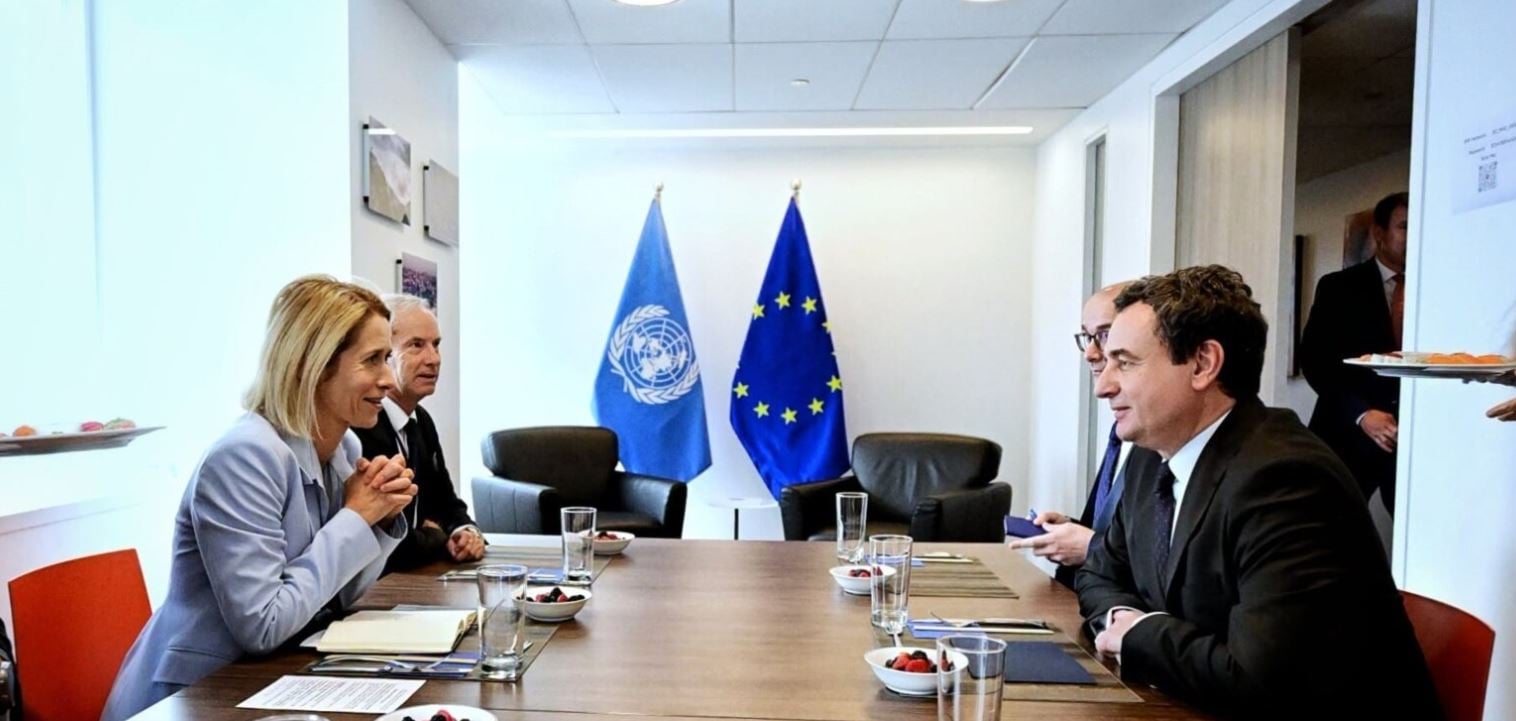
At a time when the dialogue between Kosovo and Serbia remains frozen at the political level, European Union foreign policy chief Kaja Kallas called in New York for concrete movement from both sides. After separate meetings with Prime Minister Albin Kurti and Serbian President Aleksandar Vucic, Brussels’ message was clear: existing agreements cannot be treated as statements without consequences.
The EU’s message: agreements are binding
The meetings took place on the sidelines of the United Nations General Assembly, where Kallas met separately with Kurti and Vucic.
According to her statement, progress in normalizing Kosovo-Serbia relations must move in parallel with the path toward the European Union. She stressed that the agreements reached in the EU-mediated dialogue, especially the Ohrid Agreement, are binding.
Kallas added that implementing them is not a favor to Brussels, but an obligation to citizens and the region. She also said the EU will remain an impartial mediator, but suggested that the lack of political will in Pristina and Belgrade remains the real obstacle.
Blocked dialogue and Kurti’s condition over Banjska
Kurti and Vucic have not met within the framework of the dialogue since September 2023. Kosovo’s prime minister has conditioned the continuation of talks on the surrender of suspects in the Banjska attack, for which he blames Serbia.
During the meeting in New York, Kurti recalled that September 24 marks three years since the Banjska attack, in which police officer Afrim Bunjaku was killed, while three Serbian attackers were also killed in the subsequent clashes.
Responsibility for the attack was claimed by Milan Radoicic, former vice president of the Serb List. Kosovo has repeatedly sought his extradition from Serbia. In his public reaction, Kurti asked for the EU’s support in pressuring Serbia so that, according to him, those involved face justice in Kosovo.
Both the EU and the United States have also called for those involved in the attack to be held accountable before justice.
What Vucic said after the meeting
On the other hand, according to the version made public by Vucic, the conversation with Kallas focused on Serbia-EU relations, reforms aimed at membership, and regional stability, including the position and security of Serbs in Kosovo.
The Serbian president said Serbia remains committed to dialogue with its European partners. However, the meeting produced no signal of overcoming the deadlock that has long blocked the political process between the two countries.
Kurti also raised the issue of the Specialist Chambers and Albanians in Serbia
After the meeting with Kallas, Kurti said he had expressed concern over the sentences handed down to four former KLA leaders by the Specialist Chambers and that Kosovo, according to him, will work to have the ruling changed on appeal.
On September 16, Hashim Thaci, Kadri Veseli, Jakup Krasniqi and Rexhep Selimi were found guilty on four counts of war crimes and sentenced to a total of 81 years in prison. At the same time, protests are being held in Pristina against the ruling, while other reactions at the countrywide level have also been announced.
Kurti also raised concern about Albanians in southern Serbia, describing them as discriminated against and underrepresented in institutions. He also mentioned the practice known as passive address deregistration, which, according to long-standing claims raised by the Kosovo side and Albanians in the Presevo Valley, results in the loss of civil and social rights.
Along the same line, Kurti said Kosovo remains oriented toward the EU and NATO, while accusing Serbia of moving between the influence of Russia and China. Belgrade has previously been criticized by the United States and the EU for not imposing sanctions on Russia and for its closeness in the field of armaments with Moscow and Beijing.
The meetings in New York showed once again that European mediation continues, but without guarantees that the sides are ready to move from their hardline positions.
Beyond diplomatic statements, the issues holding the dialogue hostage remain the same: implementation of agreements, accountability for Banjska, and the lack of political trust between Pristina and Belgrade.