
Prime Minister Edi Rama used the stage of the Euronews Summit 2026 to push forward the government’s narrative about the “transformation” of Albania in tourism. According to his version, the country has gone from around 2 million visitors at the beginning of this journey to 12 million foreigners last year, while the stated objective remains ambitious: “the world”
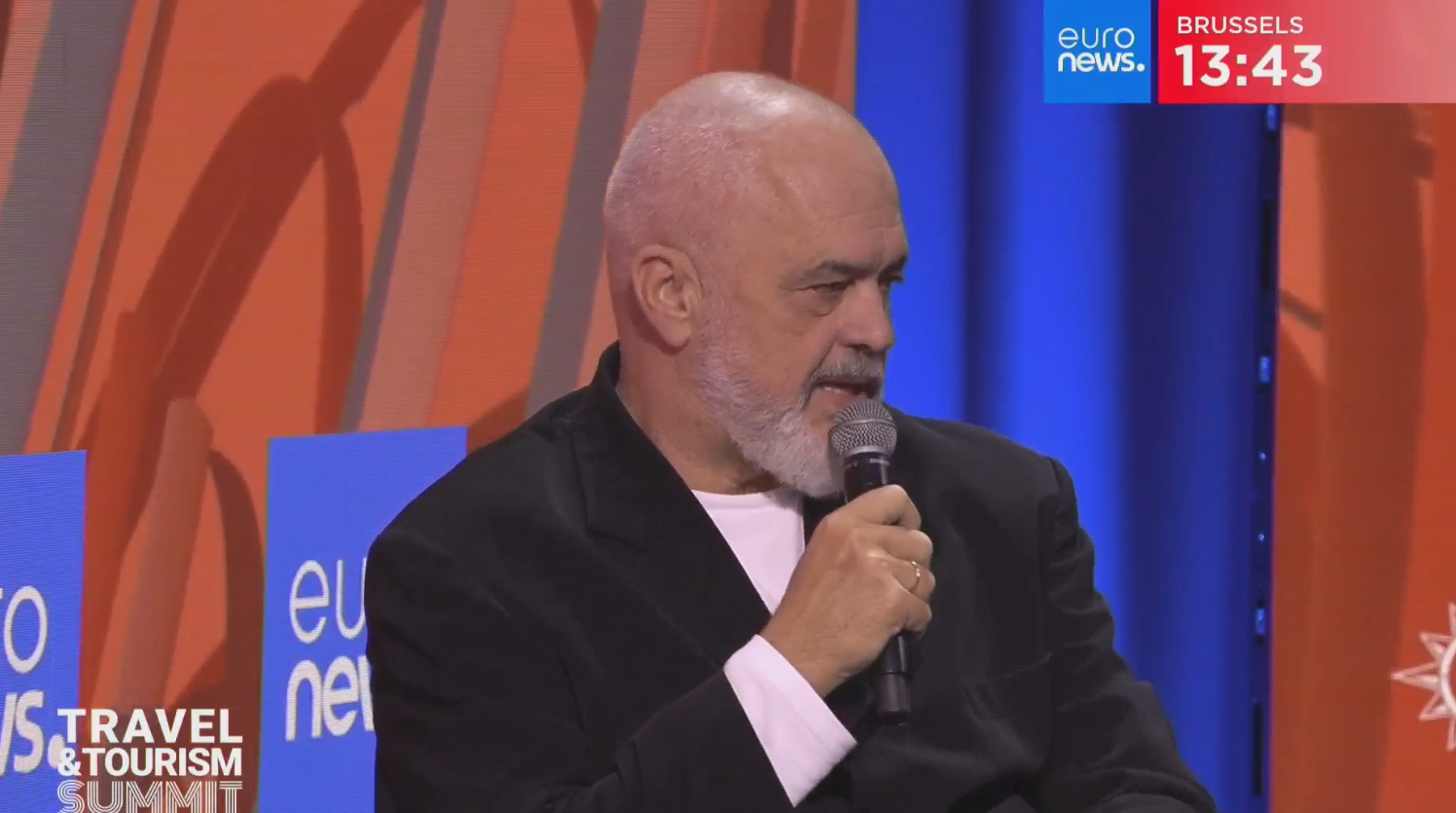
Rama sells Albania as a global destination
During his speech, Rama presented Albania as a destination that is attracting more and more tourists from different countries around the world. He insisted that the country has entered a phase in which it can be presented beyond the old stereotypes that, according to him, have accompanied it for years.
Along these lines, the head of government used strongly promotional language, saying that anyone who does not visit Albania today remains among the few who do not. His message was clear: Albania is being marketed as an international tourism product, and the government wants to expand this market even further.
Tourism figures, the strongest part of the presentation
The central point of Rama’s speech was the growth in the number of tourists. According to him, at the start of this “transformation” Albania counted around 2 million tourists, while last year it closed with 12 million foreigners.
He used this comparison to support the claim that the country has entered a different level of international exposure. Rama mentioned that this flow now also includes visitors from Japan, Australia, China, and Israel, to underline that the tourism market is no longer relying only on the region or nearby Europe.
Security, hospitality, and nature: the government’s familiar package
In his presentation, Rama listed the arguments the government often uses to promote Albania: security, quality of life, food, hospitality, and natural diversity. He said the country offers two seas, nine rivers, and mountains, presenting this mix as a strong advantage for tourists looking for many experiences within a few days.
This is the familiar official marketing framework for Albanian tourism, where the emphasis is placed on potential and growth. What was left out was a more critical assessment of the pressure that this growth places on infrastructure, territory, and the long-term management of destinations.
The goal is “the world,” but without many details on the plan
Rama declared that a plan exists and that the government is working on it, while the final aim, according to him, is for Albania to target the global market. He linked this to the effort to change the country’s image and bring it out of the shadows of isolation and stereotypes from the past.
However, beyond the political statement and motivational language, no further details were given on the concrete content of this plan, the pace of investment, or how a further expansion of tourist flows will be handled. At this point, it remained more a presentation of ambition than a full explanation of the real costs and capacities.
At the Euronews Summit, Rama chose to present an Albania that, according to the government, has entered the global tourism map. Figures and superlatives took the main place in this public message.
What remains to be seen is how much this growth translates into sustainable development and how much of the declared success stands even beyond the promotional stage.