
Prime Minister Edi Rama has sharpened his rhetoric against the protest that has been ongoing for five days, claiming that the violence on the boulevard is inspired by similar developments abroad and that a “foreign hand” is also behind it. In his statement, the head of government portrayed the participating students as being manipulated by extremist elements, but without offering public evidence for the accusations raised.
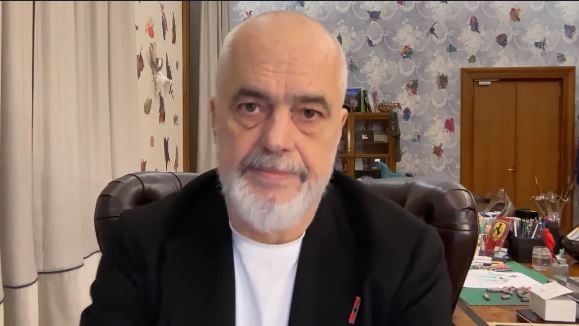
Strong accusations from the prime minister
According to the version made public by Rama, the protest is part of a broader wave of events that, according to him, are also appearing in other cities such as Paris, Rome, Milan, Turin, Portugal and Brazil.
The prime minister said that in Albania this situation takes on a special meaning because of the political moment which, according to the government, is linked to the goal of joining the European Union in 2030. Along these lines, he described the protest as part of an attempt to strike the country at what he considered a decisive stage.
Students described as “hostages” of a “fire group”
In his remarks, Rama drew a distinction between dissatisfied young people and the group that, according to him, is directing the clashes on the ground. He claimed that the students on the boulevard are “hostages” of a “fire group” at the head of the protest.
According to the prime minister, there are masked individuals at the protest and the use of minors as shields to limit the police response. This claim, too, was not accompanied in the public statement by concrete evidence or verifiable data.
Claim of criminal involvement and a “foreign hand”
Rama went even further when he declared that “crime is also there” within the protest and that a “foreign hand” is behind the events. This is an accusation with significant political and public weight, which at this stage has been articulated as a claim by the head of government.
In the absence of publicly presented evidence, the statement raises more questions than clarifications about what is actually happening on the ground and about the factual basis of the accusations made by the government.
Political rhetoric at the height of tensions
The statement comes at a moment of heightened tension after five days of protests accompanied by episodes of violence. Instead of offering full transparency about the organizers, those responsible, and the institutional management of the situation, the head of government chose language that shifts the focus to external enemies, extremism and infiltration.
This kind of rhetoric, often used in situations of political crisis, remains to be judged on facts and not on broad labels directed at protesters or specific social groups.
So far, the prime minister’s public statements have placed the emphasis on a scenario of outside incitement and the manipulation of students, but without providing verifiable elements to support this version.
At its core, the issue remains open between what the government presents as an organized threat and the need for the public to receive evidence, not just political labeling.