
The protests of recent days are being read as the toughest political test for the government after more than a decade in power. In a television interview, analyst Gabriel Partos argues that the discontent cannot be reduced to the usual scheme of “external factors,” while linking the main responsibility to domestic problems: the cost of living, education, lack of prospects, and corruption.
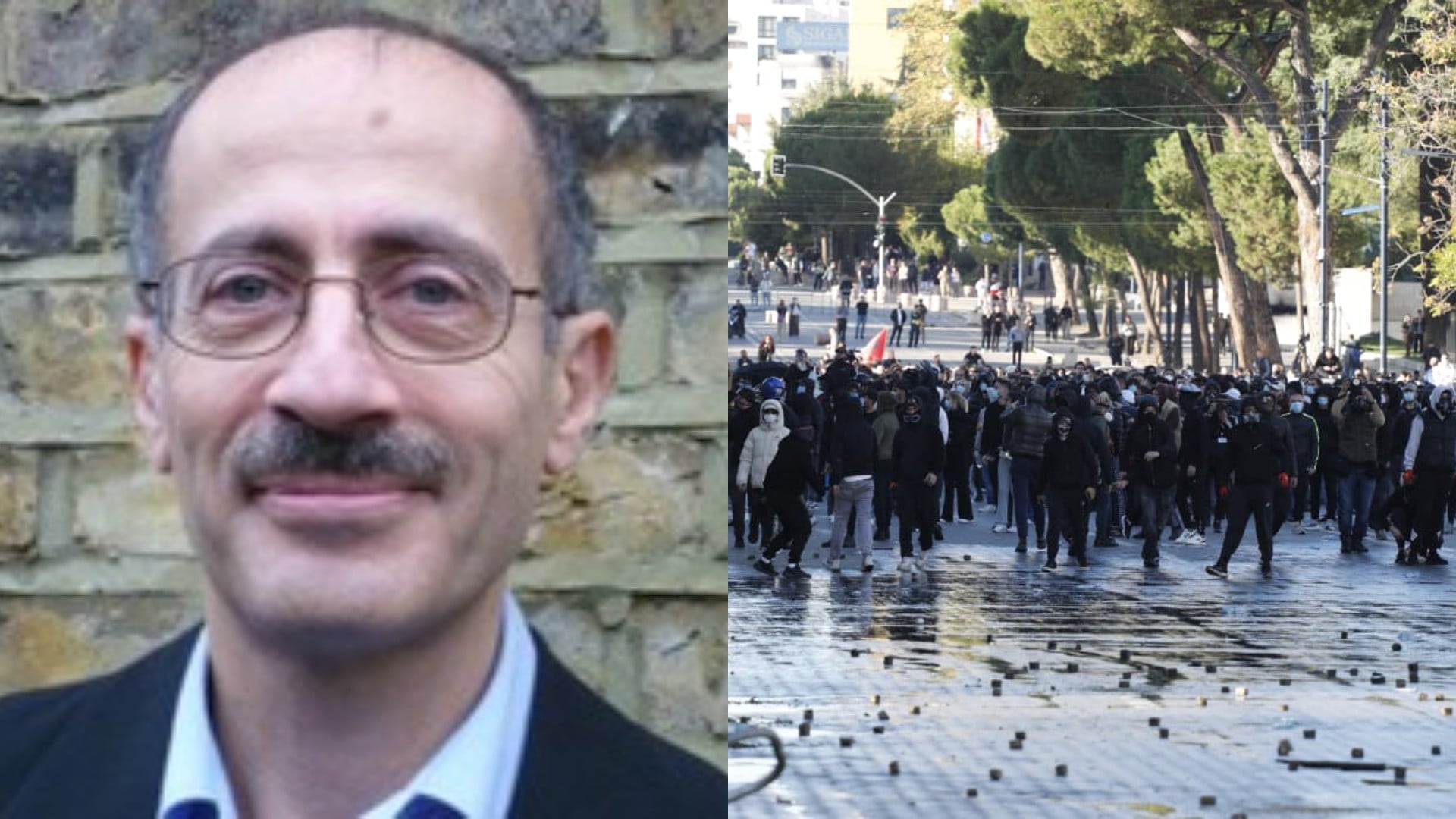
The protests, the biggest challenge for the government
Partos describes developments in Tirana and other cities as the most serious challenge to Edi Rama’s leadership in 13 years as prime minister. According to him, not only the scale of the demonstrations, but also the level of violence gives this wave of protests particular political weight.
In this reading, the current protest is not seen as an isolated episode, but as the continuation of a longer social and political discontent. This makes it harder for the situation to be treated simply as a public order problem, as the official version often seeks to present it.
Social discontent and corruption at the center
The analyst lists several of the main causes that, in his view, are fueling the anger: the high cost of education, the cost of living, the lack of prospects for young people, and continuing corruption. He also links this climate to the departure of young people abroad, in what has for years been known as brain drain.
At this point, Partos’ assessment runs counter to efforts to minimize the discontent as a reaction of the moment. He suggests that what we are seeing is an accumulation of old, unresolved problems that are turning into direct political pressure on the government.
“Foreign hands”? Partos does not see it as the main cause
Faced with the prime minister’s accusations of outside interference, Partos says he does not believe the cause of the protests should be sought in foreign actors. According to him, even if there may be attempts at influence from countries such as Russia or accusations against other actors, they are not enough to explain the eruption of this discontent.
He mentions Russia as the most likely actor in terms of a geopolitical interest in weakening the EU and the Euro-Atlantic space, while also mentioning the possibility of other forms of involvement. However, his main message is that responsibility for the protests is rooted in domestic causes and cannot easily be shifted abroad.
Rama a “victim of his success,” but under growing pressure
Partos says Rama has become a “victim of his personal success,” referring to his fourth re-election and the wear that comes with a long stay in power. According to this assessment, the longer a government lasts, the more discontent and the political costs of unmanaged problems accumulate around it.
He adds that the prime minister’s position becomes even more difficult in a climate where high-level figures have faced serious corruption accusations. For Partos, the government should listen more seriously to the grievances coming from the protests, rather than treating them with political underestimation.
Opposition without an alternative, protests without leadership
A strong part of Partos’ analysis is linked to the weakness of the opposition. According to him, many protesters are expressing dissatisfaction not only with the government, but with the entire political class, which makes it difficult for the opposition to automatically turn the revolt into political capital.
He argues that the opposition is not convincing anyone that it has a new alternative, nor the capacity to build a broader front against the government. In this situation, the protest remains without clear leadership, something that could weaken it politically, even though pressure on the government remains high.
Partos also warns that escalating tensions could have consequences for the political climate and for the European integration process. According to him, if the confrontation deepens and reforms, especially those related to the rule of law and corruption, remain stalled, the road toward the EU could be obstructed or delayed.
The message emerging from this analysis is twofold: the government is facing a real crisis of confidence, while the opposition is failing to fill the gap with a convincing alternative.
In these conditions, the protest appears more as an open indictment of the political system than as clear support for a particular camp.