
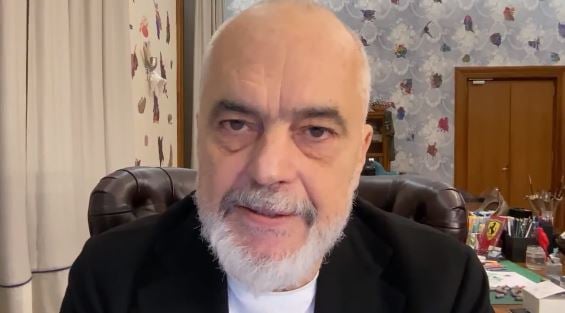
Prime Minister Edi Rama has chosen to place the protests and calls to make way for the younger generation in opposition to the process of negotiations with the European Union, constructing a political message in which opposition to the government is presented as a risk to the country’s European course.
Political message: from protests to the EU negotiating table
In his statement, Rama said that what is at stake is not related to personal power, but to the negotiating table with the EU. According to him, the question is not simply who comes next, but whether Albania moves toward the European Union or turns back.
This line of argument shifts the debate from dissatisfaction with governance to fear over the political consequences of change. In essence, the prime minister presented the alternative as a choice between continuing the current course and returning to the past.
Justice as an argument in defense of the government
Rama also touched on justice, declaring that it has brought powerful people forward. His message was that this is proof the country is moving ahead and that the system is not sparing influential figures.
However, the statement remains at a political level and is not accompanied by other explanatory elements on the standard of equality before the law or on public expectations for investigations reaching the highest levels of power.
Response to calls for him to step aside
Commenting on calls for him to make way for the youth, Rama responded with the question of what comes next. According to his version, what may follow is not a step forward, but the return of a past for which, as he said, the country has paid a price.
This is a familiar political line of the majority: every demand for rotation or change is presented as a destabilizing risk, rather than as a normal part of democratic accountability.
Comment on young people and disinformation
In the same appearance, the prime minister also spoke about what he called the chaos of disinformation. He mentioned young people who, according to him, are influenced by models of displaying money on social media and feel worthless by comparison.
This argument too was used to link social tension to external influences and distorted perceptions, more than to the concrete problems that fuel public dissatisfaction.
Rama also said that he no longer sees power as a personal ambition and that he no longer has any desire to travel or meet major figures in world politics for the sake of the post. But the core of his message remained the same: according to the prime minister, the current political battle should be viewed through the lens of negotiations with the EU, not simply through the fate of his government.