
A phone call with a student was used by Prime Minister Edi Rama to once again turn attention to the protest and the way dissatisfaction with the government has been articulated. In his version, the head of government says he heard calls every day for “prison” and “resignation,” but not concrete demands that, according to him, would justify his departure.
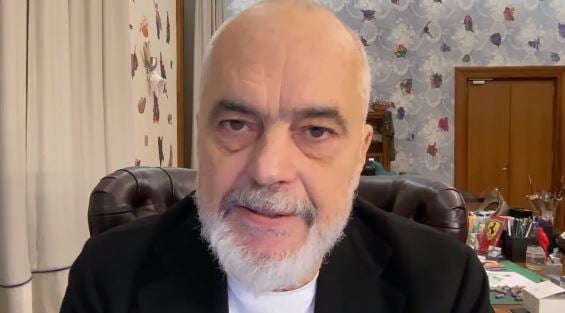
The phone call Rama presented as an example
Rama said he had communicated with a student who had sent him a message and whom he later called by phone. According to him, the student told him that the protesters “have not been heard,” while he replied that he had continuously heard their calls throughout the protest.
According to the way he presented the public conversation, these were not articulated as direct demands in relation to the prime minister’s office. Rama used this episode to argue that there had been a lack of structured communication with clear political or institutional demands.
The prime minister’s claim: many slogans, little dialogue
In his statement, Rama said that for “140-something days” below the window of his office he had heard only chants such as “prison, prison,” “to the gallows,” and “resign.” According to his version, no one had knocked to calmly present the reasons why he should leave.
He framed the issue as a lack of confrontation with arguments, saying that protesters should either convince him why he should go, or listen to why, according to him, he should not leave. This is an interpretation that shifts the debate from the substance of the dissatisfaction to the form of the protest.
Attacks on critics and references to other issues
During the same statement, Rama also attacked critics who, according to him, appear publicly as defenders of youth and students, while making political accusations against them over off-the-books wages and public hypocrisy. He did not provide additional details for these claims in the same communication.
The prime minister also touched on other issues, mentioning “the flamingos” and Zvërnec. According to him, there “the whole truth is online” and the practice is transparent. In this case as well, he presented the debate from the government’s point of view, without addressing the specific objections that have publicly accompanied these issues.
A political response that avoids the core of the discontent
Rama’s statement places the emphasis on the tone of the protest and not on its content. Even while acknowledging that there had been continuous anger below his office, he insisted that there had not been sufficient demands to serve as a basis for political reflection.
This approach leaves open the question of whether the government is treating the protests as a problem of communication and image, rather than reading them as a signal of distrust toward institutions. In essence, the prime minister’s response was more a counter-accusation against protesters and critics than an explanation of the reasons for the anger that he himself admitted he had heard every day.
Rama used the conversation with the student as proof for his thesis that the protest had not brought him clearly articulated demands. But the very way he constructed the public message shows that the clash remains open: the government speaks of a lack of arguments, while dissatisfaction on the ground appears to continue to be expressed as strong distrust toward it.
Politically, the statement did not offer any new step toward dialogue, but only reaffirmed the prime minister’s defensive position in the face of a protest climate that he described as hostile.