
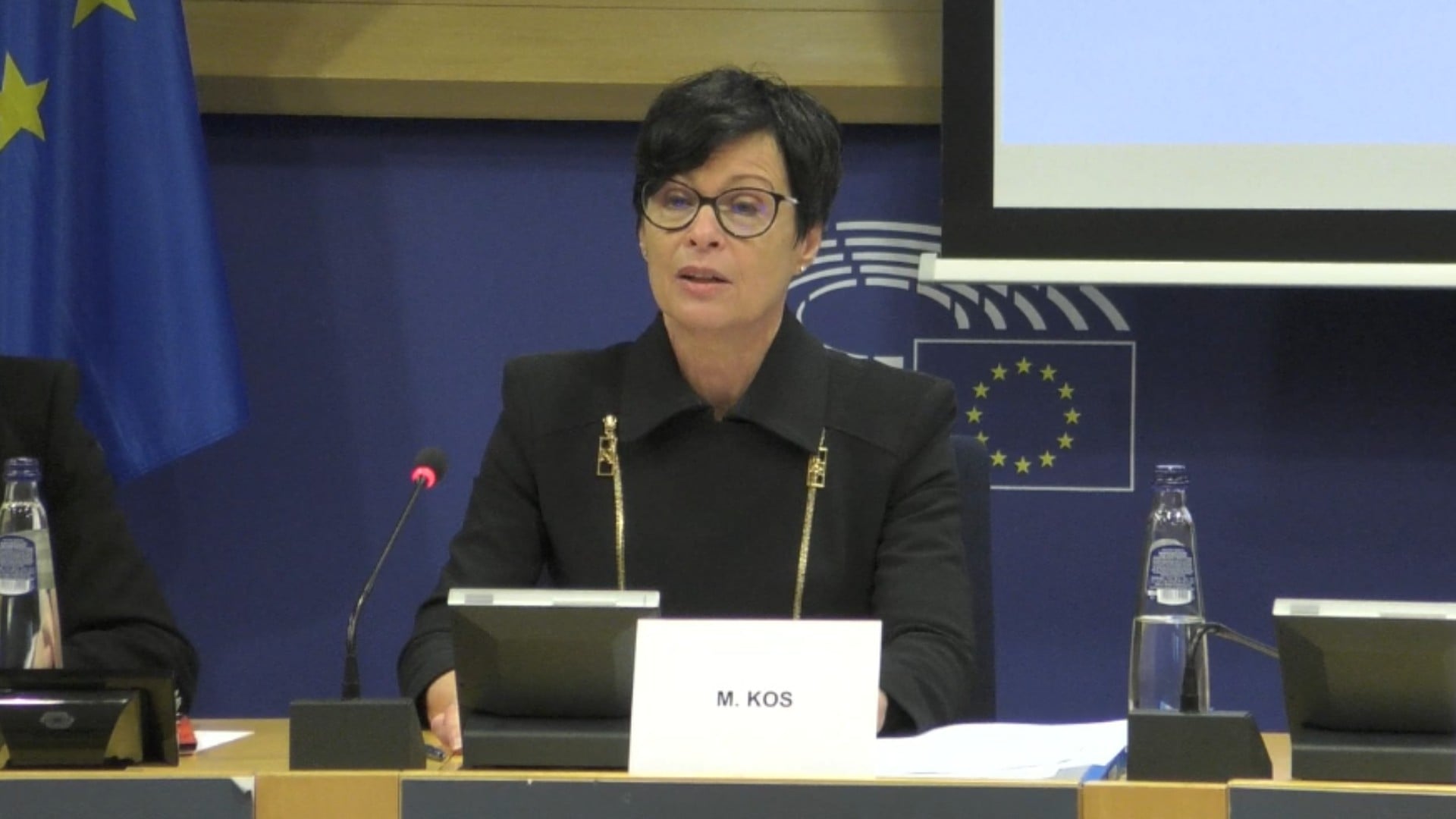
EU Enlargement Commissioner Marta Kos acknowledged in the European Parliament that Kosovo has been hit by institutional deadlock, which according to the Commission’s version has directly affected the implementation of reforms linked to the European Union. At the same time, Brussels is putting on the table a new model of gradual integration for candidate countries, a formula aimed at giving them more benefits before full membership.
The 2026 report and the political signal from Brussels
In presenting the 2026 enlargement report, Kos said the progress of candidate countries depends on political will and on the political choices made by their governments. The Commission’s message was clear: the pace of rapprochement with the EU is not presented as an automatic process, but as the result of reforms and institutional stability.
For Albania, Ukraine and Moldova, she said the roadmaps define the outlook for next year. For Kosovo, the tone was more critical, as the Commission linked the slowdown to the institutional blockage during the reporting period.
Kosovo, between public support and institutional blockage
According to Marta Kos’s statements, Kosovo has remained committed to the European path and enjoys a high level of public support for that course. But that support, according to the report, has not been enough to avoid the consequences of the institutional crisis on the pace of reforms.
She stressed that the institutional deadlock has affected the implementation of EU-related reforms, although she added that the reform agenda has recently intensified. The Commission also mentioned its expectation that institutional stability will return after the election of the new president.
The new model of gradual integration
One of the main points of the new package is the proposal for a model of gradual integration. According to the Commission, the idea is for countries in the enlargement process to benefit from “more Europe” even before formal EU membership.
In the first quarter of next year, special dialogues with candidate countries are expected to begin in order to assess existing measures and the possibilities for further integrating steps. Brussels presents this as a more coherent and predictable approach, but it remains to be seen how concrete the benefits will be and how much political delay will be avoided under another name.
Montenegro in the lead, Albania awaiting the next step
In her speech, Kos placed Montenegro at the head of the enlargement process. According to her, it is the most advanced country and has a chance to become the 28th member of the European Union in 2028.
She said 21 chapters have been closed with Montenegro and 14 others remain, while work on the Accession Treaty has begun. For Albania, the Commission did not give a similar political deadline, limiting itself to the assessment that the roadmap defines the outlook for next year.
Security, migration and organized crime in the enlargement package
The Commission is increasingly linking enlargement with European security. According to Marta Kos, developments in countries in the enlargement process have direct consequences for EU security, including disinformation, cyberattacks and organized crime.
In this logic, gradual integration is presented not only as a political or economic issue, but also as a mechanism for better information-sharing, greater control over migration and stronger coordination against external pressures. Ukraine was mentioned separately by the Commission as an example of resilience in the face of war and as a factor that, according to Brussels, also strengthens Europe’s own security.
The new enlargement package shows that the EU is trying to preserve the political momentum of the process, but also to manage the chronic slowness of full memberships with intermediate formulas.
For Kosovo, the Commission’s message remains twofold: support for the European course, but also a clear signal that without institutional stability and functioning reforms, rapprochement with the EU is unlikely to move forward on political declarations alone.