
Prime Minister Edi Rama, appearing in Dublin before an audience of diplomats and experts on European affairs, chose to defend the government’s record on corruption and to question the scale of the protests in Albania. Instead of a direct response to public discontent, he insisted on the official version that corruption is being fought and that the protest movement changed in nature after the summer.
The meeting in Dublin and the message on integration
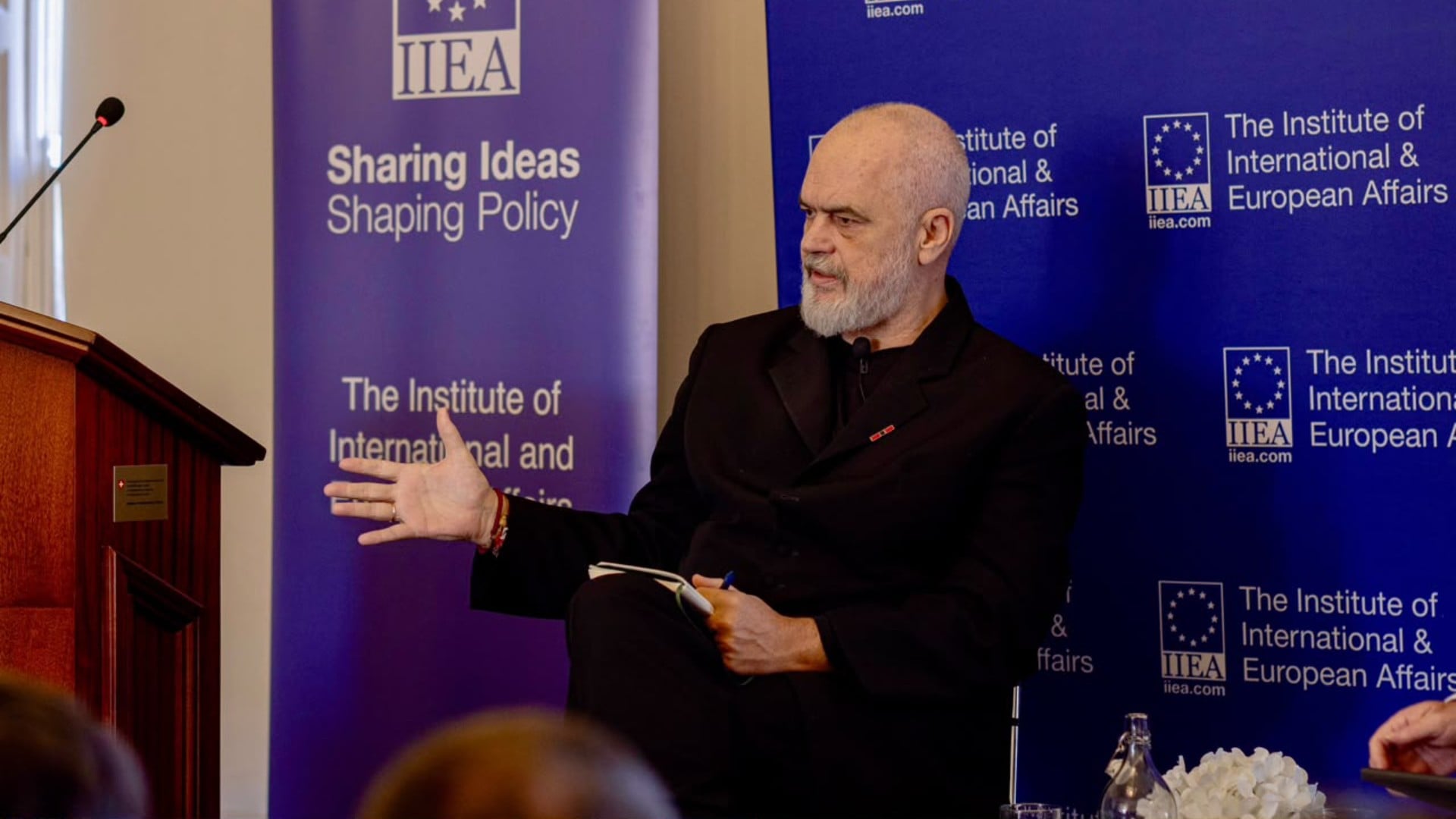
Rama is in Dublin, Ireland, at the invitation of the Institute of International and European Affairs, where he spoke about Albania’s European path under the theme “Albania’s European Journey: From Aspiration to Integration”.
At the forum, the prime minister said his concern remains attracting investment and ensuring that development is grounded in the rule of law. He insisted that judging the integrity or corruption of individuals is not done by the “public square,” but by the courts.
Protests, numbers and the clash with public perception
Asked about the protests and dissatisfaction over corruption, Rama disputed claims of very high participation, saying the figure of “hundreds of thousands” does not match the country’s population and the size of the boulevard.
According to his version, there were mass protests in June, but the situation later changed. He said that after that period the protest “was not the same” and used an ironic comparison when he declared that “there are no more flamingos,” but “other birds” and political parties from the far right and the far left.
In the same answer, Rama also referred to the earlier claim of foreign influence through social media, saying he had not accused protesters of being sent by the Iranian regime, but that Iran, according to him, had intervened through social networks.
Corruption, according to the government: from system to open fight
In defense of his government, Rama acknowledged that the problem of corruption exists, but claimed that for the first time it is truly being fought. According to him, “until some time ago the system was corruption,” whereas now the country is “in a good position.”
The statement comes at a time when corruption remains one of the most sensitive issues in public debate and one of the main tests for institutions, beyond the political formulas used on international stages.
Position on Russia and criticism of Europe over Ukraine
In the same discussion, Rama also spoke about the war in Ukraine and relations with Russia. He said Albania has in practice had no meaningful relations with Moscow, recalling the historical rupture in ties dating back to the dictatorship period.
However, he criticized Europe’s approach to the war, saying the continent has erred by setting diplomacy aside and focusing on armaments. According to him, a Europe that delegates the effort for peace to other political figures will remain open to reproach in history.
Rama added that Russia “is not going anywhere,” suggesting that, in his view, a solution cannot be built without a diplomatic approach.
Rama’s appearance in Dublin was used not only to speak about European integration, but also to repeat the government’s narrative on the protests, corruption and external influence.
Precisely where clarification was sought on the credibility of institutions, the political response remained one of relativizing criticism and defending the government’s record.