
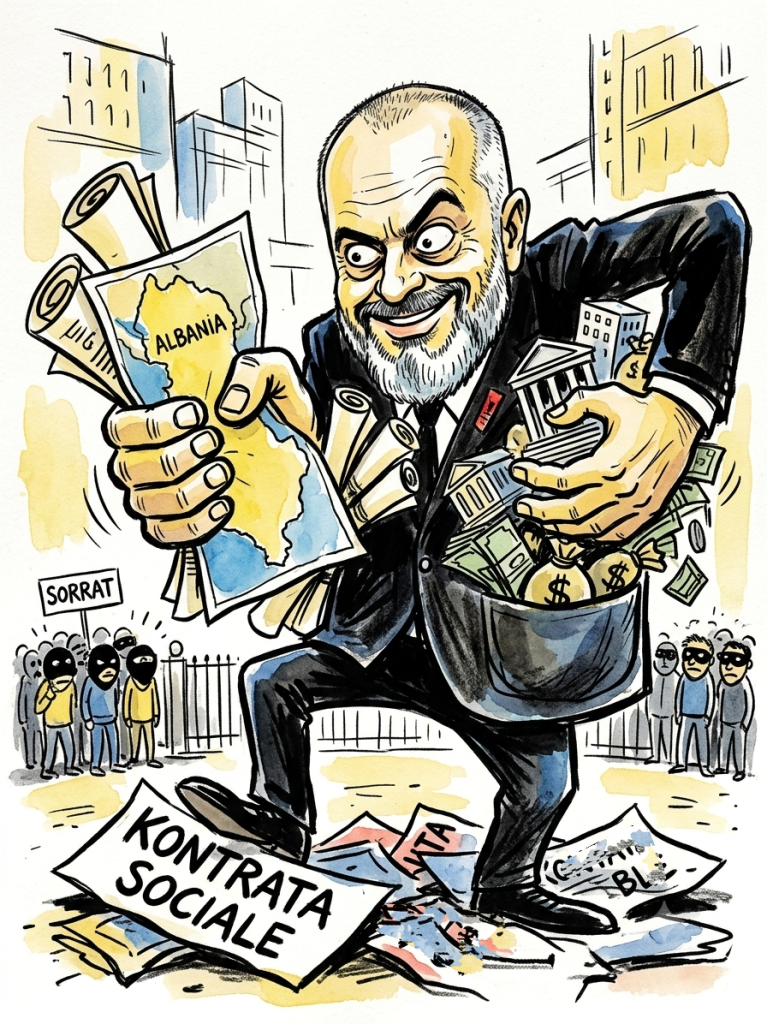
If a leader chooses to define his power through the logic of private enterprise and clientelist relationships, then he is no longer leading a state, but managing a company with limited shares. Edi Rama’s latest statement, in which he casually and with unmatched arrogance tells protesters that he has “no contract” with them because they did not give him their vote, amounts to a direct blow to the very foundational principles of constitutionalism and democracy.
This is not merely a rhetorical debate or the latest political clash. This is the public dismantling of the concept of the rule of law.
Depersonalization of power and the logic of the “owner”
When a politician sits in the Prime Minister’s chair, he sheds the suit of the party in order to assume the function of representative of the entire people. The mandate comes from elections, but the legitimacy of governing is exercised over every citizen — regardless of whether that person voted in favor, against, or abstained.
The moment Edi Rama declares that his contract is “the property of all those with whom I signed it,” he:
- Privatizes public duty: The constitutional oath is not taken before 800,000 voters, but before the Republic of Albania. Taxes are collected from everyone, laws apply to everyone, and institutions serve everyone. To claim that this obligation exists only toward “your electoral clientele” is to delegitimize the very function of the state.
- Creates second-class citizens: By asserting that he has no obligation or contract with the opposition or with protesters, the Prime Minister denies them the status of members with equal rights in the political community. This is a violation of the principle of equality before the law.
Dehumanization as an instrument of power: From language to the degradation of the institution
The use of metaphors such as “crows,” “ravens,” or “black feathers” to label those who take to the boulevard against him is not merely a lack of political culture — it is a deliberate strategy of dehumanization.
In the history of political thought, stripping the opponent of human dignity and reducing them to “dark birds” serves to justify refusing to respond, avoiding accountability, and closing every channel of communication. When protesters are portrayed as unworthy of having a “pledge” or a dialogue, power frees itself from any kind of moral and political responsibility toward them.
And while the opposition is branded with the epithet of “dark creatures,” supporters and the prime minister himself are elevated as “flamingos.” This banal and divisive rhetoric is unacceptable for the head of a government that claims European integration.
The danger of delegitimizing governance itself
If a prime minister governs only for those who voted for him, logic suggests that taxes, laws, and his authority should belong only to them as well. But what about the rest of society? Should it obey the laws of a power that openly declares it has no “contract” with it?
This is the direct road toward the dissolution of the social contract. A leader who sees the country as divided between “owners of the contract” and “crows without rights” has lost the moral right to represent the country nationally and institutionally.
Democracy is not the dictatorship of the majority over the minority, much less a private administrative relationship. If Edi Rama refuses to understand that the office of the Prime Minister belongs to all Albanians — including those who protest every night below his window — he simply proves that he may have the numbers to remain in power, but has lost every reason to be the prime minister of this country.