
Prime Minister Edi Rama acknowledged that businesses in Albania remain unprotected in the digital space, as he presented an ambitious package for the state’s technological infrastructure. At the Second Innovation Forum, he spoke about establishing a public cloud, national computing capacity and data centers, linking this to data security and digital services.
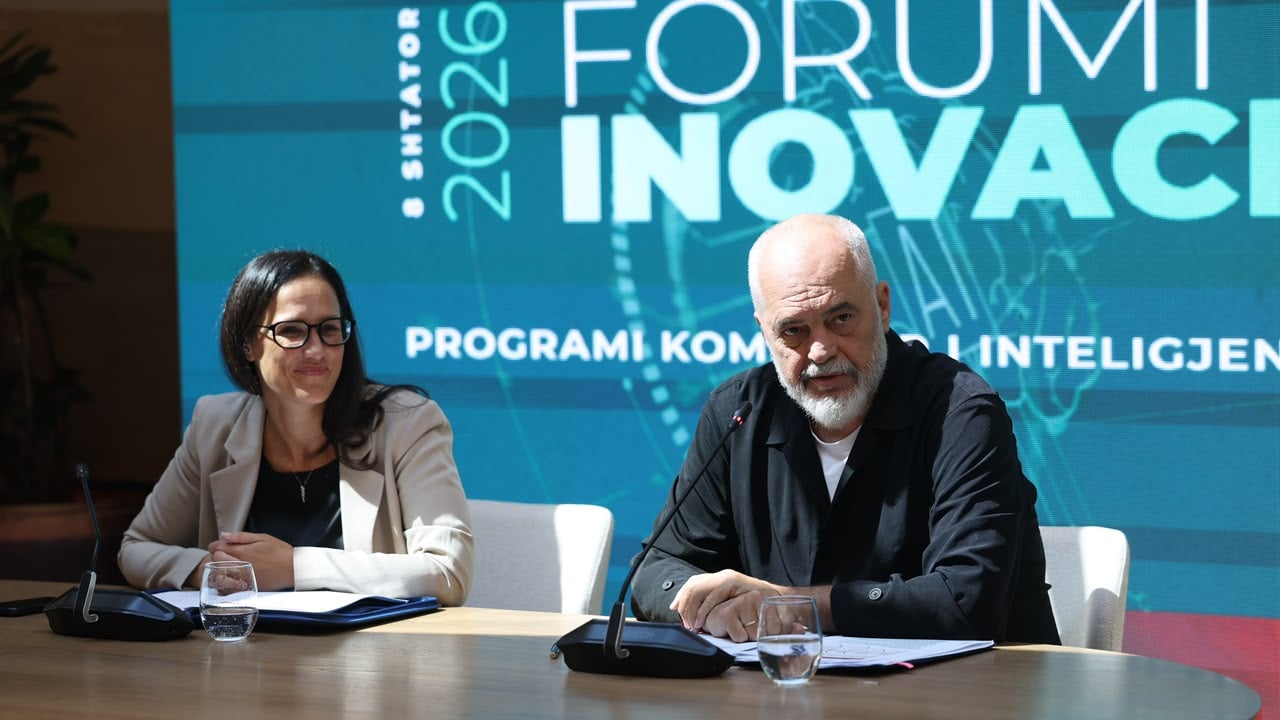
Alarm for the private sector, according to the government’s version
At the center of the remarks was the warning that the private sector is exposed to cyber risks. Rama said businesses operating online remain at low levels and called for preventive measures, also recalling previous attacks on state platforms.
This is a direct admission that digitalization is not moving at the same pace outside the administration, despite the government’s long-running rhetoric on technological modernization. The concern voiced by the prime minister himself also raises questions about the market’s and institutions’ real readiness to cope with such risks.
The plan for a public cloud and national capacity
According to Rama, the government aims to build a public cloud structure and a national computing capacity, with the idea that state data would be accessed securely by entrepreneurs and the academic world. He also mentioned a service catalog, which he said would help the faster and more accurate construction of digital solutions.
It was also announced that the possibility of building data centers is being explored, although Rama himself acknowledged that this process is more complex than it appears. So far, no deadlines, costs or concrete details have been given on how these structures will be financed and administered.
Government speaks of strong growth in technology
Figures for the technology sector were also presented at the forum. According to Rama, exports have reached 222 million euros, about three times the level of a few years ago, while nearly 30,000 professionals are active in this sector.
He said 7 out of 10 protagonists in the sector are under the age of 35 and that technology’s share of total national output has reached 2.2 percent. The target announced by the government remains for technology exports to reach 1 billion euros, a major goal that for the moment was presented without a detailed implementation roadmap.
Startups and the verbal attack on portals
Rama said support for startups will continue, while also dwelling on the pressure that, according to him, has been exerted on them by some portals. In the same appearance, he also used disparaging language toward media outlets that criticize these policies.
His statement briefly shifted attention away from the main issue, that of digital security and public infrastructure. More than clarifications on standards, data protection or institutional responsibility, the forum produced another series of major objectives that remain to be seen whether they will move from the podium to implementation.
In essence, the government’s message was twofold: on the one hand, the growth of the technology sector was promoted; on the other, it was acknowledged that private businesses are still weak in the face of cyberattacks.
This is precisely where the real test remains for institutions: not in announcing new plans, but in the transparency, financing and concrete security of the systems that affect public data and economic activity.