
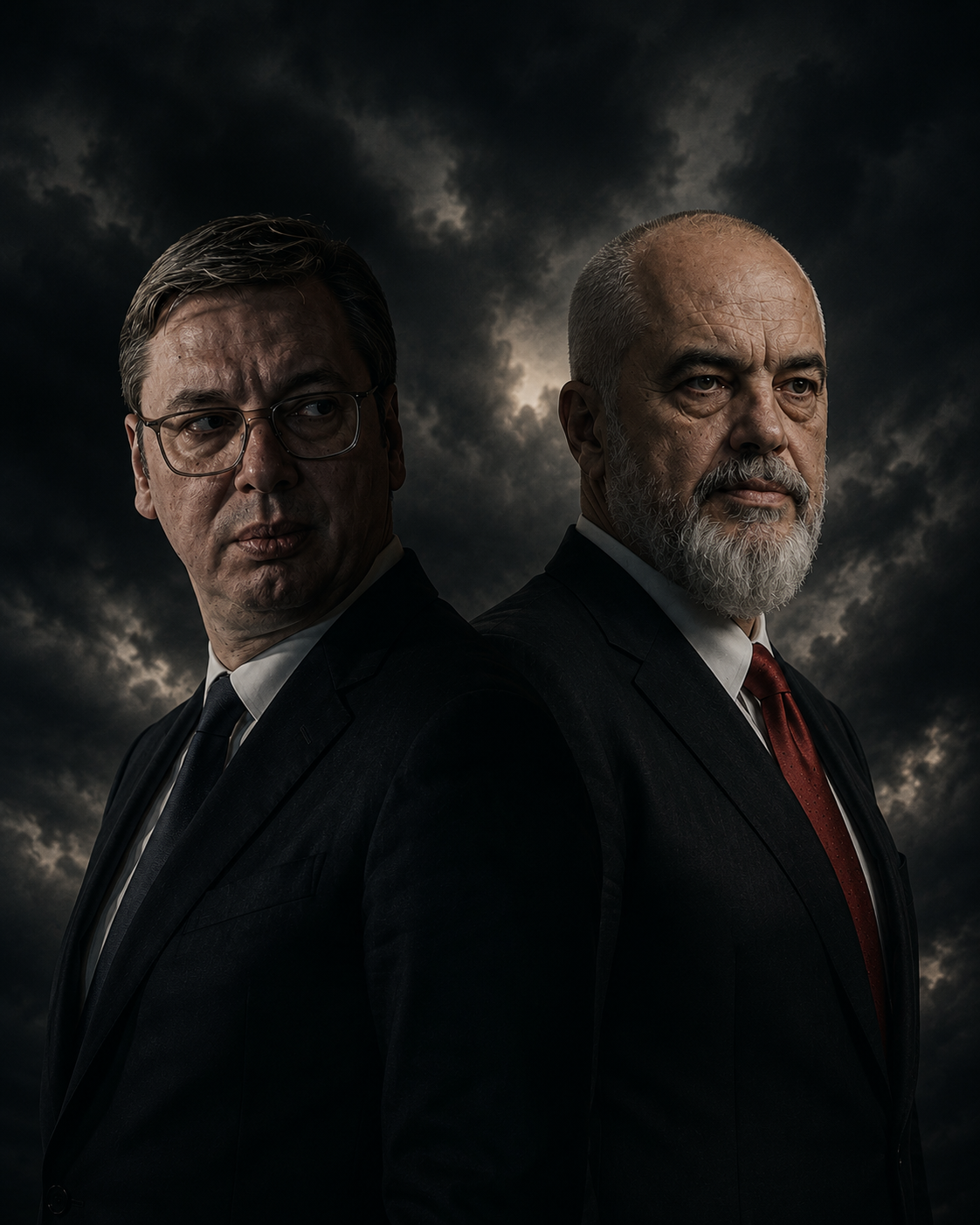
How Edi Rama and Aleksandar Vučić built political systems that increasingly revolve around themselves
For more than a decade, Edi Rama in Albania and Aleksandar Vučić in Serbia have dominated the political landscape of their respective countries. Despite representing different geopolitical camps—one firmly aligned with the West, the other balancing between East and West—their governing models have evolved in remarkably similar ways.
Neither governs through classic dictatorship. Elections are held. Opposition parties exist. Independent media continue to publish. Yet the defining question is no longer whether democratic institutions formally exist, but whether they still possess the strength to restrain executive power.
Across the Western Balkans, the emergence of what political scientists describe as competitive authoritarianism, hybrid regimes, or electoral autocracies has blurred the line between democracy and authoritarianism. Albania and Serbia increasingly illustrate this phenomenon.
The Politics of One Man
The most striking similarity is the personalization of power.
In both countries, politics has become inseparable from the personality of the leader. Government achievements, diplomatic successes, economic policies, and even national identity are increasingly presented through the image of a single individual.
Institutions remain, but political gravity has shifted toward the executive leader.
Parliament becomes secondary.
Cabinets become extensions of the leader’s office.
Political parties increasingly function as instruments of loyalty rather than platforms of ideas.
Winning Elections Is Not the Same as Protecting Democracy
Both leaders have repeatedly secured electoral victories.
However, democracy is measured by more than elections.
Its health depends on whether opposition parties compete on equal terms, whether institutions act independently, whether courts remain insulated from political influence, whether journalists investigate without intimidation, and whether state resources are separated from partisan interests.
The central concern expressed by numerous democratic observers is not necessarily electoral fraud itself, but the cumulative advantage enjoyed by long-entrenched incumbents.
Power becomes self-reinforcing.
The longer it lasts, the more difficult genuine political competition becomes.
The Architecture of Power
Every long-serving political system develops its own ecosystem.
Appointments.
Economic networks.
Public procurement.
State advertising.
Media influence.
Business elites.
Security structures.
Each component may appear legitimate in isolation.
Together, they create an environment where political loyalty becomes increasingly valuable and institutional independence increasingly fragile.
This is not necessarily repression through force.
It is often control through dependency.
Two Different Foreign Policies, One Domestic Logic
On foreign policy, Rama and Vučić diverge sharply.
Rama presents Albania as one of the European Union’s most reliable partners in the Western Balkans and maintains close alignment with NATO and the United States.
Vučić has instead pursued strategic balancing between Brussels, Washington, Moscow, and Beijing, leveraging Serbia’s geopolitical position.
Yet domestically, both leaders have demonstrated a similar instinct: consolidating executive authority while portraying themselves as the indispensable guarantors of stability.
The message is simple.
Without them, chaos.
With them, order.
The Weakening of Institutional Restraints
Modern democracies rarely collapse overnight.
They erode gradually.
Institution by institution.
Norm by norm.
Appointment by appointment.
The concentration of influence over public administration, regulatory bodies, state enterprises, and political communication raises legitimate questions about the resilience of institutional checks and balances.
The issue is not whether institutions formally exist.
The issue is whether they can effectively constrain those who govern.
Protests as Symptoms, Not Causes
The large-scale protests witnessed in both Albania and Serbia should not be understood merely as isolated political events.
They reflect deeper frustrations over accountability, corruption, transparency, and the perception that institutional channels no longer provide meaningful remedies.
Whether every demand raised by protesters is justified is a separate question.
The existence of sustained protest itself signals a widening gap between formal democratic structures and public confidence in them.
Strong Leaders or Strong Institutions?
History has repeatedly demonstrated that charismatic leaders can modernize countries.
Few, however, leave behind stronger institutions than the ones they inherited.
That remains the defining test for both Edi Rama and Aleksandar Vučić.
If political stability ultimately depends on the continued dominance of one individual, then stability itself becomes vulnerable.
Democracies do not endure because leaders remain in power.
They endure because institutions remain stronger than leaders.
Democracy Without Alternation
There comes a moment in every political system when elections cease to answer the fundamental democratic question.
Not who wins.
But whether power can realistically be lost.
This is where Albania and Serbia increasingly resemble one another.
Both countries continue to organize elections. Opposition parties compete. Campaigns are held. Ballot boxes are counted. International observers continue to monitor the process.
Yet the political environment surrounding those elections has gradually changed.
The governing party enters every electoral contest not merely as a political competitor but as the administrator of the state itself. Years in power inevitably generate advantages that no opposition can easily replicate: control over appointments, influence over public communication, privileged access to state resources, stronger relationships with economic actors, and a public administration whose institutional memory increasingly aligns with the governing elite.
Democracy begins to change not because citizens lose the right to vote, but because the conditions under which they make that choice become progressively less balanced. Political scientists Steven Levitsky and Lucan Way describe this phenomenon as competitive authoritarianism: regimes where elections remain meaningful, yet incumbents benefit from systemic advantages that steadily erode the level playing field.
The transformation is rarely dramatic.
It is incremental.
Almost invisible.
And therefore far more durable.
The State Slowly Becomes the Government
Modern authoritarianism rarely abolishes institutions.
It absorbs them.
The parliament continues to convene.
The courts continue issuing judgments.
Regulatory agencies continue functioning.
Public broadcasters continue broadcasting.
Everything appears normal.
Yet over time, institutional autonomy begins to diminish.
Appointments increasingly reward political loyalty alongside professional competence.
Senior civil servants understand that career progression often depends as much on political alignment as on administrative performance.
Business leaders become cautious.
Independent media weigh every investigation against its financial consequences.
The result is not necessarily censorship.
It is anticipation.
People begin adjusting their behavior before pressure is ever applied.
This is perhaps the most sophisticated form of political control.
Fear no longer needs to be communicated.
It becomes internalized.
Stability as Political Currency
Both Rama and Vučić have mastered a central argument of twenty-first-century politics.
They present themselves not simply as elected leaders but as indispensable guarantors of national stability.
The message resonates domestically and internationally.
Foreign governments value predictability.
Investors prefer continuity.
Regional partners seek stability.
As long as economic growth continues and geopolitical alignments remain favorable, concerns over institutional decline often receive secondary attention.
This creates what many analysts have called the stabilocracy dilemma: governments praised for maintaining regional stability while simultaneously facing criticism for weakening democratic accountability.
The paradox is profound.
The stronger the leader appears, the weaker the incentive becomes to strengthen institutions capable of replacing that leader.
The Psychology of Permanent Power
Long-serving governments undergo a subtle psychological transformation.
Victory ceases to be an achievement.
It becomes an expectation.
Political opposition is no longer viewed as an alternative government.
It becomes an obstacle to national progress.
Criticism is interpreted less as democratic oversight and more as sabotage.
Journalists become adversaries.
Civil society becomes suspect.
Independent institutions become inconvenient.
Every system centered on one dominant political figure eventually begins to confuse criticism of the government with criticism of the state itself.
This may be the earliest warning sign of democratic erosion.
Because democracies survive disagreement.
Personalized political systems do not.
The Balkan Question
The defining question facing the Western Balkans is no longer whether elections will continue to take place.
They almost certainly will.
The real question is whether future generations will inherit political systems capable of replacing governments without first enduring prolonged crises.
History offers a simple lesson.
Strong leaders inevitably leave office.
Strong institutions outlive them.
Countries built around institutions recover.
Countries built around personalities begin each political transition from the beginning.
That distinction may ultimately determine whether the Western Balkans completes its democratic transformation—or merely perfects a more sophisticated form of executive dominance.